


If you are a high-wealth individual investor trying to understand private markets without getting lost in jargon, the “capital stack” is one concept worth learning early. Not because it is fancy, but because it’s how real businesses actually get built.
A capital stack is simply the order in which money shows up. Early money proves demand. Later money scales what works. Some money buys time. Some money buys distribution. And each layer changes what the next layer is taking on.
Reg A+ matters in this sequence because it adds a very specific option. The SEC itself notes that a Regulation A offering is sometimes referred to as a “mini IPO,” and it allows companies to sell securities to the public through a process similar to, but less extensive than, a registered offering.
Start with the funding ladder, not the hype
A decade ago, the default path was easier to describe: angels, venture capital, maybe some debt, then an IPO or acquisition.
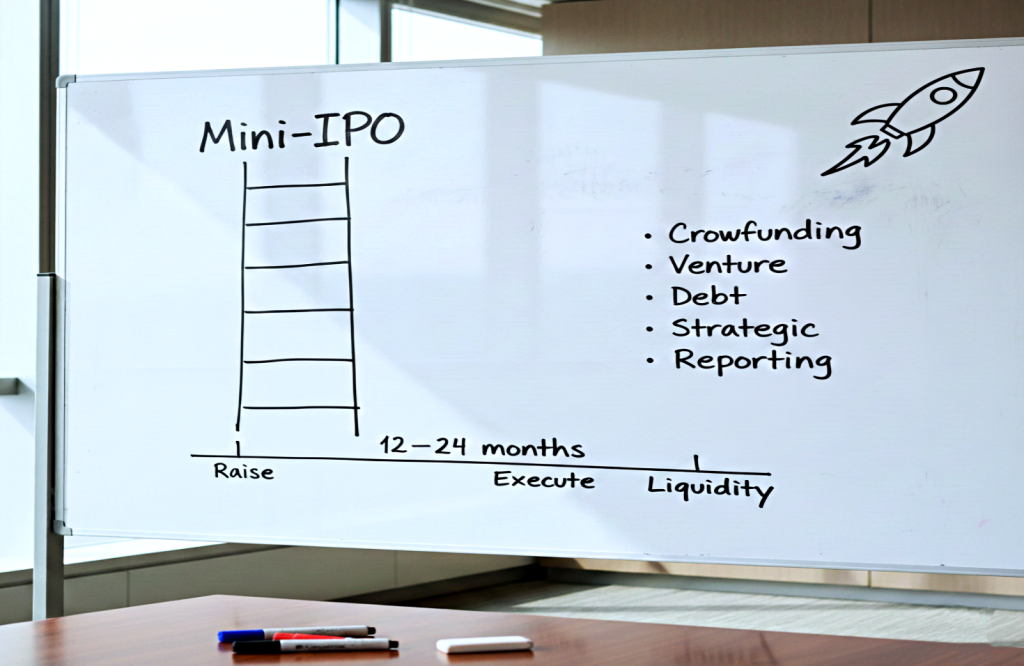
Today, companies mix and match. They might start with online fundraising to prove customer pull. They might take venture capital to hire fast. They might add debt when revenue becomes predictable. They might bring in a strategic investor because it unlocks distribution. Reg A+ can show up in more than one of these spots, and where it sits tells you what the company is trying to do next.
When you know where a mini-IPO fits in the ladder, the deal becomes easier to evaluate. You stop asking, “Is this exciting?” and start asking, “What does this money actually accomplish?”
What a mini-IPO really is in plain English
Regulation A has two tiers: Tier 1 (up to $20 million in a 12-month period) and Tier 2 (up to $75 million in a 12-month period).
For individual investors, the practical difference is that Tier 2 comes with a more defined reporting rhythm. The SEC’s guidance for issuers highlights that Tier 2 offerings have additional requirements, including audited financial statements and ongoing reporting on EDGAR.
That doesn’t make a company “safe.” It does make it easier to follow what the company said it would do, and what it is actually doing after the raise.
How Reg A+ can sit next to crowdfunding
Crowdfunding often shows up early, when a company is still proving demand, building a community, or validating product-market fit. Regulation Crowdfunding (Reg CF), for example, permits eligible companies to raise up to $5 million in a 12-month period through an SEC-registered intermediary online.
A mini-IPO can become the next rung when the company needs more capital than early crowdfunding typically provides, and when it’s ready to operate with a higher level of disclosure. The optimistic version of this progression is simple: early capital proves people want it, later capital scales the machine.
As an investor, you are looking for continuity. Does the company’s fundraising path match its business maturity, or is it raising because it has to, not because it has a clear plan?
How Reg A+ can sit next to venture capital
Venture capital is often optimized for speed. It’s designed to fund aggressive hiring, product expansion, and land-grab growth. When a company uses a mini-IPO alongside venture, it’s often because it wants another lane of growth capital without relying entirely on traditional VC cycles.
From your perspective, the key question is not whether venture is involved. The key question is what the proceeds are meant to do. Is the company scaling something already working, like a repeatable acquisition channel or a proven product line, or is it still searching for its basic engine?
A mini-IPO works best when it funds expansion of something that already has traction, because that’s when capital behaves like an accelerator rather than a life raft.
How Reg A+ can sit next to debt and private credit
Debt is about predictability. Lenders want a clean story around repayment capacity and protections if things tighten.
A mini-IPO can complement debt when the company wants to strengthen the balance sheet, fund growth without over-leveraging, or reduce reliance on expensive short-term financing. In other words, it can be equity that makes the overall stack healthier, which can matter a lot if the company intends to keep scaling responsibly.
For you, this is often a positive signal when it’s paired with a business that already shows revenue quality. If cash flows are still inconsistent, debt becomes a stress multiplier. If cash flows are stabilizing, the stack starts to look like a plan instead of a gamble.
“A mini-IPO is often less about a splashy moment and more about giving a business a trackable lane to raise and operate with more discipline.”
How strategic investors fit into the same picture
Strategic capital is the layer that can look like marketing but sometimes isn’t. A strategic investor might invest because they can help with distribution, enterprise relationships, supply chain access, or credibility in a regulated market.
If a company has strategic capital in the stack, treat it as a practical question: does this relationship change the company’s ability to win and keep customers, or is it just a logo and a press release?
When strategic relationships truly matter, you usually see it show up downstream in customer acquisition, retention, or unit economics.
What the reporting cadence means for you after the raise
For many individual investors, the hardest part of private investing is not deciding to invest. It’s knowing what to watch afterward.
This is where Tier 2’s reporting rhythm can be helpful. The SEC’s guidance notes Tier 2 issuers file annual reports on Form 1-K within 120 calendar days after the fiscal year ends, semiannual reports on Form 1-SA within 90 calendar days after the first six months of the fiscal year, and current reports on Form 1-U within four business days for specified events.
That cadence can make the post-investment period feel less like guessing. You can track whether the company is hitting milestones, whether it is using proceeds as described, and whether the fundamentals are strengthening.
What “good” looks like in a mini-IPO capital stack
A mini-IPO looks strongest when three things are true.
First, the company can explain why this tool is the right fit now, not just why it’s available.
Second, the use of proceeds maps to a real bottleneck you can understand, like scaling distribution, expanding capacity, or improving unit economics.
Third, the company is prepared for the ongoing discipline that comes with operating in a more public-facing way under Tier 2.
If you keep coming back to the stack, the entire story becomes easier to read. You’re no longer evaluating a pitch in isolation. You’re evaluating the next step in a sequence, and whether that step actually moves the business forward.