

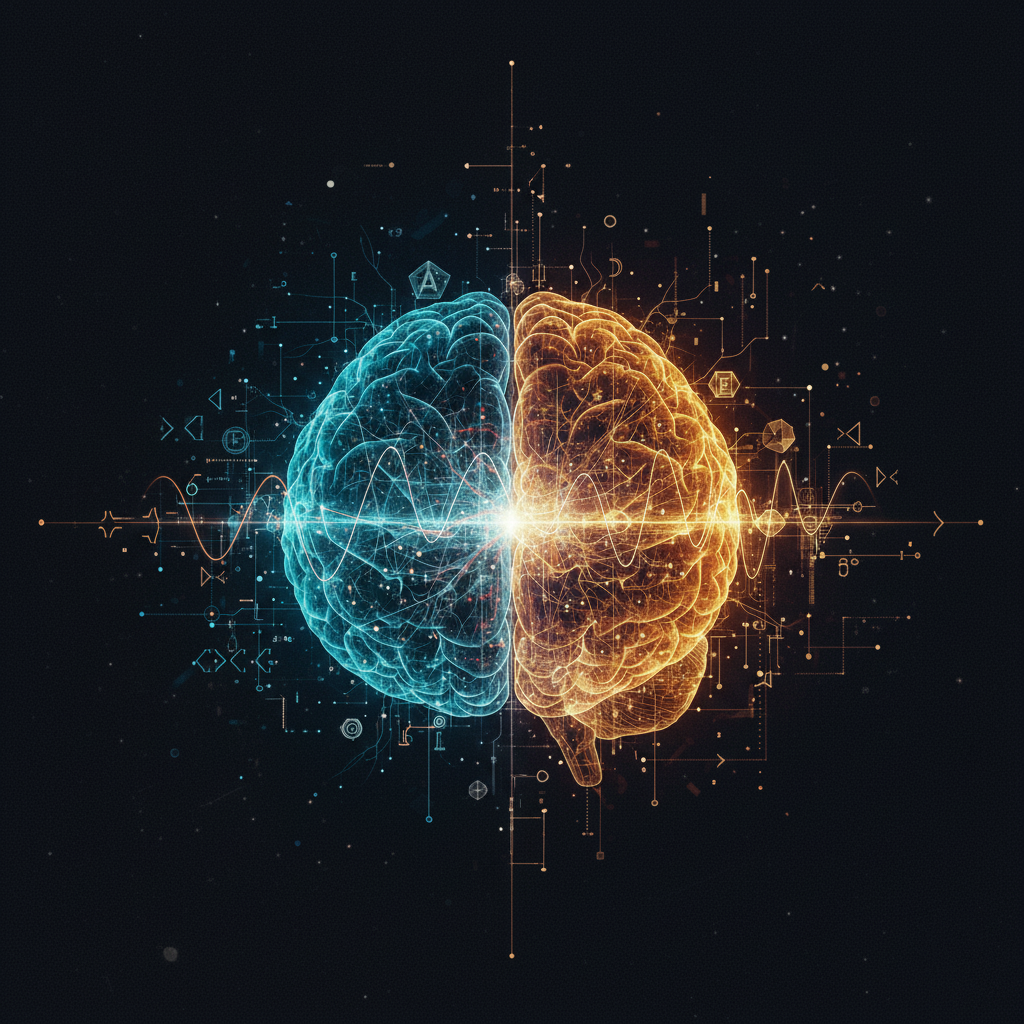
How neuro-symbolic AI is redefining machine intelligence.
For the past decade, AI progress has focused on scale. This means bigger models, more tokens, and larger GPU clusters. However, in 2025, researchers are moving toward a different kind of progress. They aim for systems that can reason, not just predict.
This shift centers on neuro-symbolic AI, a hybrid approach that combines deep learning with clear reasoning frameworks. Unlike earlier waves of machine learning, this one isn’t driven by the number of parameters. Instead, it relies on structure.
Why Pure Neural Nets Hit a Limit
Neural networks excel at perception and pattern matching, but they struggle with logic, abstraction, and consistency over long chains of thought.
This is a well-known limitation documented across the field:
• The Stanford HAI 2024 AI Index Report found that large language models still underperform on symbolic reasoning tasks compared to specialized systems.
(Source: Stanford HAI 2024 AI Index, Chapter: Technical Performance)
• The Allen Institute for AI reported that LLMs systematically fail on benchmarks requiring multi-step deductive reasoning.
(Source: AI2 Aristo Reasoning Benchmark, 2024)
• Meta AI researchers published work showing that LLMs diverge on tasks requiring strict logical operators or relational consistency.
(Source: Meta AI “Neural Networks and the Limits of Logical Generalization,” 2023)
These findings create what researchers refer to as the reasoning gap. This is a major weakness of purely neural models.
Pattern recognition built the last decade. Reasoning will build the next.
What Neuro-Symbolic AI Actually Combines
Neuro-symbolic AI merges two approaches:
1.Neural components → learn from examples and handle perception
2.Symbolic components → apply rules, logic, constraints, and explicit knowledge
This hybrid design addresses exactly where neural nets fail.
The idea is not new, but major institutions have pushed it forward with real, documented progress:
• IBM’s Neuro-Symbolic AI work has shown dramatic improvements in tasks requiring explainability and rule-following.
IBM’s 2022–2024 papers in AAAI and NeurIPS established practical neuro-symbolic architectures for visual question answering.
• MIT CSAIL research on “compositionality” continues to demonstrate that hybrid models generalize better from fewer examples.
Source: MIT CSAIL, “Compositional Abstractions in Neural Models,” 2023–2024.
• Google DeepMind’s AlphaGeometry system (2023) solved thousands of Olympic-level geometry problems using a hybrid neural + symbolic approach.
Source: Nature article, January 2024.
AlphaGeometry is one of the strongest real-world proofs that combining learning with logic can exceed pure neural nets.

Why It Matters Now
Three forces are pushing neuro-symbolic systems into mainstream use:
1. Regulation and Compliance
Finance, healthcare, and government now need explainable AI. Symbolic components provide clear, auditable reasoning chains. Deep nets alone cannot offer this.
2. Efficiency Pressure
As model training becomes much more expensive, hybrid systems can reach similar reasoning ability with significantly less computing power. This matches findings from the Stanford HAI Index, which show that energy use is increasing among frontier models.
3. Reliability
Symbolic systems enforce constraints that reduce hallucination — a documented weakness of LLMs across academic benchmarks.
The Shift From Scale to Structure
The AI field is no longer united behind the idea that bigger is always better.
Across research labs and industry groups, a new consensus is forming:
• Deep learning provides intuition.
• Symbolic reasoning provides structure.
• Together, they form systems that can both learn and understand.
Neuro-symbolic AI represents the logic upgrade — the next layer above pattern recognition.