

X-energy, Inc. filed its S-1 registration statement with the SEC on March 20, 2026, setting up what could be the first pure-play advanced nuclear company to reach the public markets in a generation. The company intends to list on the Nasdaq Global Select Market under the ticker “XE,” with J.P. Morgan, Morgan Stanley, Jefferies, and Moelis & Company acting as lead bookrunners. Renaissance Capital estimates the raise at approximately $300 million, though the number of shares and price range have not yet been determined.
The timing is not coincidental. Every major technology company with a balance sheet is currently trying to solve the same problem: where do you get gigawatts of firm, always-on, carbon-free power for AI data centers that run every hour of every day? Renewables can’t do it alone. Natural gas doesn’t satisfy the zero-carbon commitments most of these companies have made. That leaves nuclear — specifically, a new generation of smaller, faster-to-build reactors that don’t require the decade-long permitting fights of their 1970s predecessors. X-energy is making a direct bid to be that answer.
11 GW+
$1.2B
$1.5B+
Orderbook across
U.S. and U.K. partners
DOE ARDP cost-share
commitment (up to)
Total private capital
raised to date
What X-Energy Actually Builds
Founded in 2009 by aerospace entrepreneur Kam Ghaffarian and now led by J. Clay Sell — a former U.S. Deputy Secretary of Energy — X-energy designs the Xe-100, a high-temperature gas-cooled small modular reactor that produces 80 megawatts of electricity per unit, scalable to a four-pack generating 320 megawatts. The reactor runs on TRISO-X fuel, a proprietary tri-structural isotropic particle fuel the Department of Energy has called “the most robust nuclear fuel on Earth.” Unlike conventional light-water reactors, TRISO fuel cannot melt down in the traditional sense — the ceramic coating on each fuel particle provides its own containment.
The reactor design’s key commercial appeal is modularity. X-energy describes its Xe-100 as road-shippable, with accelerated construction timelines and more predictable costs than conventional nuclear. Whether that promise holds when the first reactor actually goes into the ground at Dow Inc.’s Seadrift, Texas site remains to be seen. But it is the premise on which the company has assembled a remarkable roster of partners.
Amazon, Dow, and the Orderbook Behind the Filing
The commercial logic of X-energy’s IPO rests heavily on two anchor relationships. The first is Dow Inc., which signed a joint development agreement in 2023 to deploy a four-reactor Xe-100 plant at its Seadrift Gulf Coast chemical complex — the first grid-scale advanced nuclear reactor deployed to serve an industrial site in North America. The NRC docketed the construction permit application in May 2025 and published an 18-month review timeline, with environmental review running concurrently. Construction is expected to begin in 2026.
The second is Amazon, which anchored a $500 million Series C-1 round in October 2024 through its Climate Pledge Fund. Beyond the equity investment, Amazon has options to deploy more than 5 gigawatts of Xe-100 projects across the United States by 2039, beginning with the Cascade Advanced Energy Facility in Washington state, built in partnership with utility Energy Northwest adjacent to the Columbia Generating Station. A separate agreement with UK energy firm Centrica outlines plans for roughly 6 gigawatts of Xe-100 capacity in Britain.
X-energy’s total disclosed orderbook now exceeds 11 gigawatts across approximately 144 advanced reactors, according to the company’s own disclosures at the time of its Series D close. That is a pipeline, not a backlog — no revenue flows until reactors are built and operating. But for a pre-commercial nuclear company, having Amazon and Dow as co-development partners is a categorically different risk profile than having nothing but a design.
“X-energy’s technology will help satisfy historically unprecedented electricity demand growth, driven by the development of AI and associated data center infrastructure.”
—X-energy, Inc. S-1 registration statement — March 20, 2026The Federal Backstop That Most Investors Miss
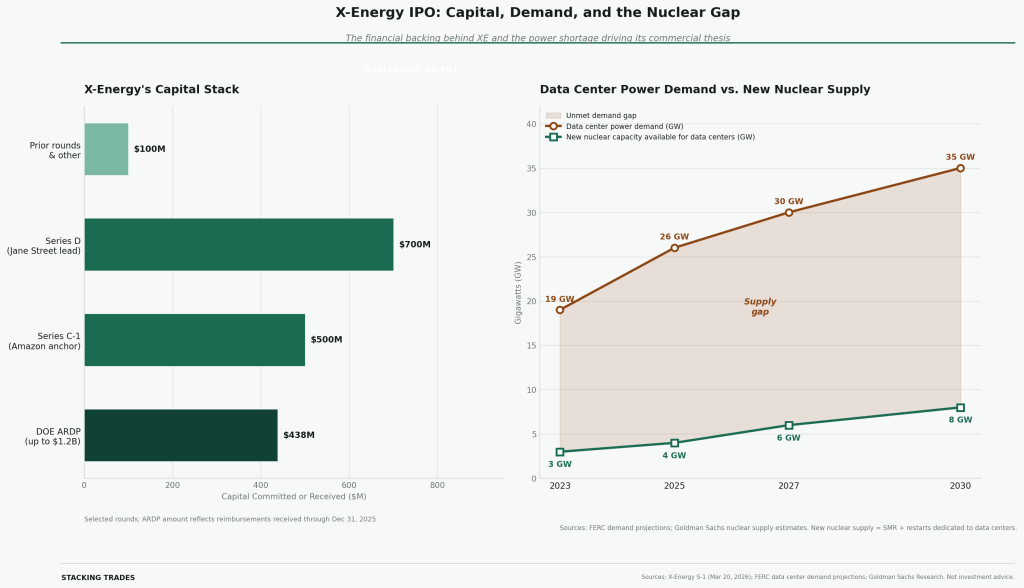
X-energy is one of two companies selected by the Department of Energy in 2020 as winners of the Advanced Reactor Demonstration Program, which provides up to $1.2 billion in federal cost-share matching to develop, license, and demonstrate an operational advanced reactor and fuel facility. By December 31, 2025, the company had received approximately $438 million in ARDP reimbursements, effectively subsidizing a significant portion of its development spend.
The TRISO-X fuel fabrication facility in Oak Ridge, Tennessee — called TX-1 — received an NRC Special Nuclear Material License in February 2026 and is designed to produce enough fuel to support the first 11 Xe-100 reactors at steady state. In April 2025, TRISO-X received the first allocation of high-assay low-enriched uranium, or HALEU, from the DOE’s HALEU Availability Program, securing fuel feedstock for the initial core loads of the Texas project. These are not minor milestones. The fuel chain is the single hardest logistical problem in advanced nuclear deployment, and X-energy has meaningfully de-risked it relative to most competitors.
The Financials: What the S-1 Shows
This is where the story requires discipline. X-energy reported $109 million in revenue and grant income for 2025, down 9% from the prior year. That decline matters. Stripping out grants, revenue from operations was approximately $94 million, against a net loss of roughly $390 million, per Bloomberg’s reporting on the S-1. The prior year’s net loss was $126 million on $84 million in revenue. The loss nearly tripled year-over-year as development spending accelerated.
The company employs roughly 916 people as of March 2026. It is in what Seeking Alpha’s IPO Edge analysis called “a high cash burn phase, with sharply rising losses, heavily negative cash flow.” That is accurate and investors should sit with it. Pre-commercial nuclear development at this stage of licensing and construction activity is extraordinarily capital-intensive. The IPO proceeds are intended to fund continued reactor licensing, construction activities, and supply chain expansion — not to make the company profitable in the near term. Profitability is a post-2030 story contingent on the Seadrift plant coming online.
Regulatory timeline risk. The NRC’s 18-month review of the Seadrift construction permit runs through approximately late 2026. Any extension or public comment complication pushes the construction start and, consequently, first revenue from operations.
Technology execution risk. No Xe-100 has ever been built. The reactor design is sound on paper and well-advanced in licensing, but first-of-a-kind construction always surfaces cost and schedule surprises.
HALEU supply chain risk. High-assay low-enriched uranium has historically been sourced primarily from Russia. X-energy received its first domestic HALEU allocation in April 2025, but fuel supply chain security for a scaled fleet remains a geopolitical dependency.
Valuation uncertainty. Share price and total raise are undetermined. Investors are being asked to price a company whose revenue case depends entirely on commercial deployments that won’t generate meaningful income until the early 2030s.
Why the Power Demand Argument Is Real
The thesis underneath X-energy’s IPO is not difficult to understand. Goldman Sachs estimates that data center electricity demand could rise 160% by 2030. The Federal Energy Regulatory Commission projects U.S. data center electricity demand will climb from 19 gigawatts in 2023 to 35 gigawatts in 2030. Goldman Sachs has further estimated that 85 to 90 gigawatts of new nuclear capacity would be needed to meet all projected data center power demand growth by 2030 — and less than 10% of that will be available globally by then.
That gap is the market X-energy is building into. It is not a manufactured thesis. Microsoft signed a 20-year power purchase agreement to restart Three Mile Island. Google contracted with Kairos Power for a fleet of SMRs targeting 2030 deployments. Meta issued an RFP for one to four gigawatts of new nuclear generation. These are not exploratory conversations. They are signed agreements and capital commitments by companies with unlimited energy budgets and existential reasons to secure reliable baseload power. X-energy has two of those companies as equity investors and development partners.
What This IPO Is Really Selling
X-energy is not a bet on current earnings. It is a bet on a structural energy transition that is already underway, on a technology that has cleared more regulatory hurdles than any other advanced reactor design in the U.S., and on a management team that includes a former Deputy Secretary of Energy and a CFO who ran corporate development for Amazon’s climate investment portfolio. Those are credentialed people with institutional backing executing against a plan that has federal cost-share and Fortune 500 anchor partnerships behind it.
The risk is time. Nuclear projects that slip slip expensively. If the Seadrift NRC review extends, if TX-1 fuel production encounters delays, or if HALEU supply chain constraints re-emerge, the cash burn against a thin revenue base will pressure the company in ways that IPO proceeds alone may not fully cushion. Investors who understand that this is an infrastructure company in the licensing phase — not a software company with a growth multiple — are the appropriate audience for this offering.
The roadshow timeline is not yet public. Based on standard SEC review periods and the March 20 filing date, trading could begin as early as May 2026. The amended S-1, which will carry the price range, is the next document to watch.
WHAT TO WATCH NEXT
- The amended S-1 with pricing terms. The first filing carried no share count or price range. The amended filing will be the first hard data point for valuation analysis and the clearest signal of where institutional demand is pricing the offering.
- NRC review progress on the Seadrift permit. The 18-month review clock started in May 2025, putting a decision around late 2026. Any NRC request for additional information or public hearing triggers would extend that timeline and reprice the risk of first commercial operations slipping past 2030.
- TX-1 fuel facility milestones. The Oak Ridge TRISO-X facility received its NRC license in February 2026. Watch for announcements of commercial fuel production beginning — that milestone converts the fuel supply thesis from regulatory to operational.
- Comparable nuclear IPO performance. X-energy will price into a market that has seen NuScale Power face cost overruns and schedule delays. How institutional investors price the sector premium or discount relative to NuScale’s public market experience will shape the deal’s reception.
- Tech company nuclear procurement announcements. Any new hyperscaler power purchase agreement or SMR development partnership announced in the pre-roadshow window will serve as real-time demand validation for X-energy’s commercial thesis.