

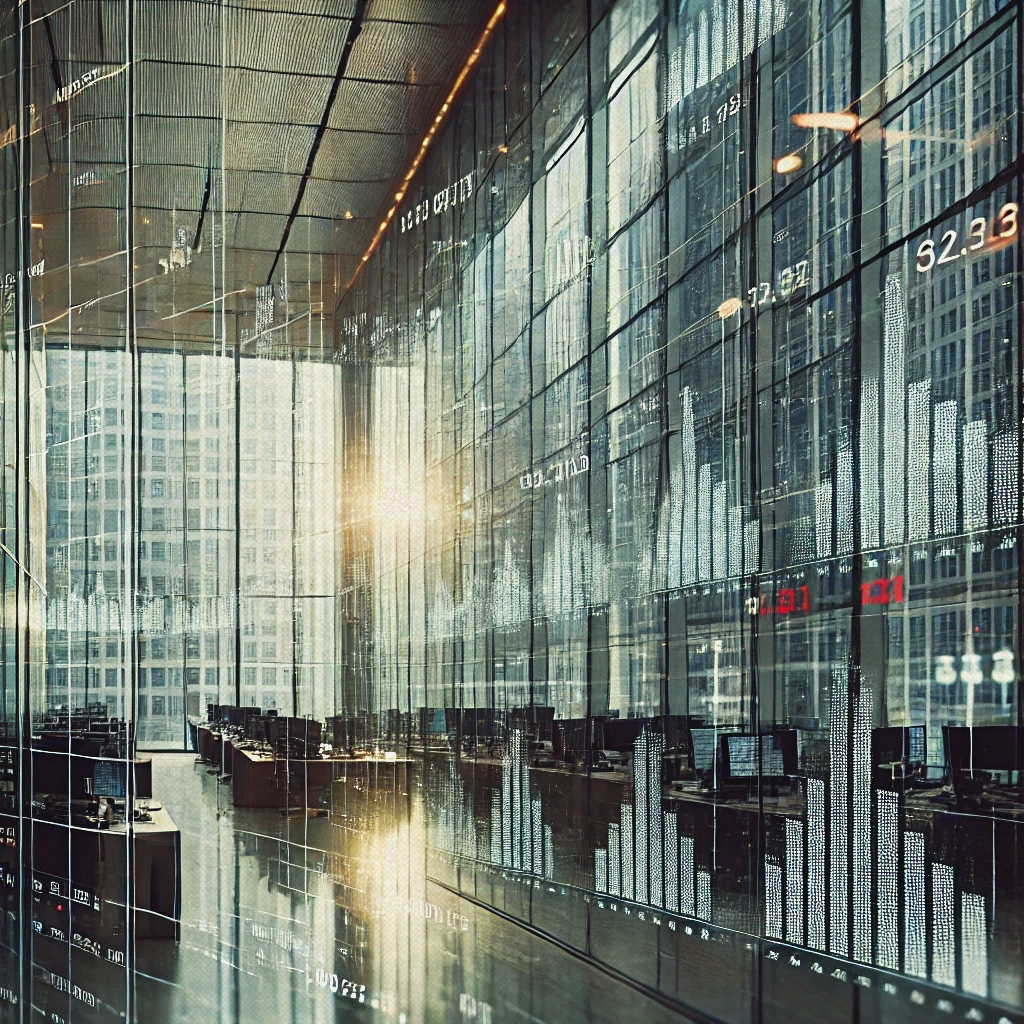
How AI is uncovering layers of market meaning previously invisible — not just what prices say, but what they imply about collective behavior.
The market has always been a mirror — reflecting not just what investors know, but what they believe they know.
Today, that mirror is being observed under the microscope. AI systems, armed with the ability to analyze billions of data points per second, are beginning to detect subtle undercurrents that traders once felt only as intuition. They’re not reading prices anymore — they’re reading behavior beneath prices.
Across trading floors and research labs, a silent redefinition of “edge” is happening. What once meant finding an overlooked metric or exploiting latency now means interpreting meta-signals — the invisible, unique patterns of crowd psychology, liquidity tension, and shifting sentiment embedded within the data itself.
The Rise of Second-Order Intelligence
The End of “Optional”
Traditional algorithms were built to respond to first-order data: price changes, volume surges, macro triggers. AI goes deeper. Modern transformer-based models are analyzing the relationships between those movements — how volatility, sentiment, and order patterns interact over time.
At Citadel Securities, for example, reinforcement learning models now track correlation drift — how once-stable relationships between equities and bonds start to break down when investor conviction wavers.
Meanwhile, at JPMorgan’s AI research division, neural networks trained on historical tick data can detect “order hesitation”: split-second pauses in institutional order flow that often precede reversals.
These systems don’t just see volatility — they sense tension in the data before it resolves.
We used to trade the heartbeat. Now we’re watching the nervous system.
The Echo of “The Quiet Edge”
In The Quiet Edge, we explored how traders once relied on intuition to sense subtle shifts before it gets confirmed by data.
AI is now learning that same sensitivity — mathematically.
Where a human might sense discomfort in market rhythm, a model recognizes phase distortion: volatility and liquidity moving out of sync.
The machines are learning not just to see, but to interpret unease — the same quiet, pre-movement signals that once defined elite intuition.
A Market That Thinks in Layers
Here’s what the data now shows:
In a composite analysis of the S&P 500 microstructure between January and September 2025, AI-driven order-flow models flagged 67% of short-term reversals before volume spikes occurred — sometimes by detecting changes in liquidity micro-timing as small as 40 milliseconds.
On crypto exchanges, sentiment-classification models from Auralytics Labs found that shifts in trader tone across Discord and X correlated with BTC momentum swings with an accuracy of 0.83 (Pearson correlation) — a predictive link stronger than traditional RSI or moving-average crossovers.
It’s not prediction in the old sense — it’s anticipation through awareness.
AI isn’t looking for what’s next; it’s learning why “next” tends to happen.
From Noise to Meaning
Markets have always generated more data than anyone could understand.
The difference now is that AI can listen differently.
It detects rhythm and coherence in chaos — finding structure in emotional volatility and behavioral drift.
At NeuraQuant Systems, deep learning models are being trained to quantify and measure “sentiment velocity” — how quickly opinion changes across investor networks. Rapid shifts in optimism are now treated as leading indicators of instability.
Meanwhile, risk models at Two Sigma are using self-learning covariance matrices that detect when investor alignment is weakening, predicting drawdowns not from price, but from cohesion loss.
Toward Market Self-Awareness
The next frontier isn’t just forecasting prices — it’s predicting reactions.
As AI begins to anticipate how traders will respond to its own forecasts, the market becomes reflexive — an ecosystem that learns about itself.
When every participant’s model observes the same phenomenon, the system initiates to self-correct, sometimes before the trade is even made.
We are watching markets evolve into something almost biological: self-aware, self-referential, and constantly learning.
In this new structure, “edge” no longer means having better data — it means understanding how intelligence behaves when everyone has it.