

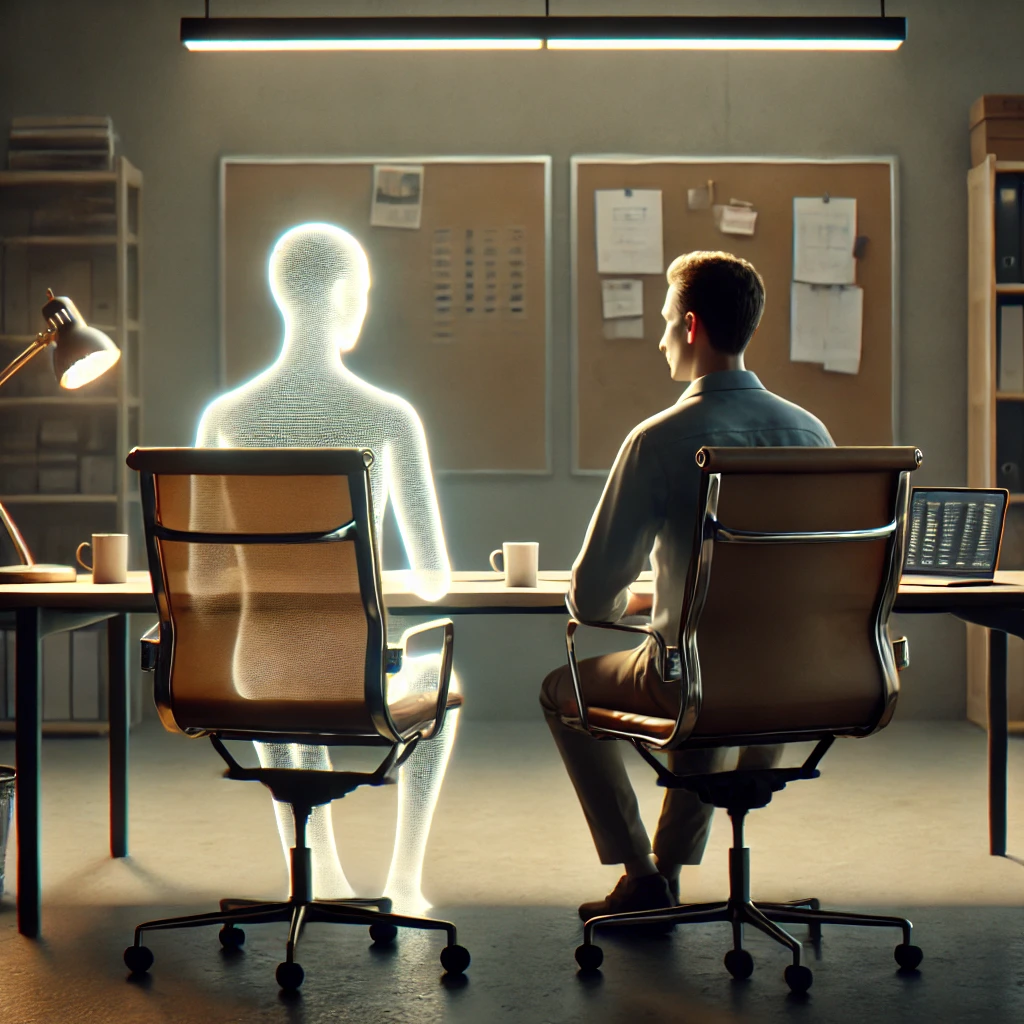
AI-Enhanced Humans and the Rise of Cognitive Companions
There has always been a quiet hierarchy in knowledge work — those who could think faster, absorb more, connect dots invisible to others. For decades, the edge came from memory, intuition, or the rare ability to hold messy ideas steady until clarity surfaced.
Now, that advantage is changing hands.
Not because humans suddenly forgot how to reason — but because the tools beside them have evolved and learned how to help. There is a new class of professionals emerging, not defined by job title or pedigree, but by how seamlessly they work alongside intelligent systems.
They aren’t “using AI” the way early computer users “used software.”
They co-think with it.
The machine drafts, they shape.
The machine surfaces patterns, they interpret.
The machine remembers everything, they decide what matters.
And the gap between those who work alone and those who work with a cognitive companion is widening faster than industries are prepared to admit.
The New Advantage: Judgment + Inference

Early automation replaced repetitive labor.
This wave does something different — it amplifies mental capacity.
Not by answering questions alone, but by increasing the quality of the questions asked.
In meetings, these augmented workers don’t say “Let me research that.”
They ask richer questions in real time because they’re never thinking with one brain.
They have:
• Memory that never decays
• Research that runs while they sleep
• Feedback without embarrassment
• Perspective that compounds instead of erodes
Their work isn’t faster.
It’s deeper.
And depth, in an age of noise, is leverage.
The First Cognitive Super-Teams
These enhanced workers aren’t defined by tools, but by habits:
• They think with their models, not after them
• They build personal knowledge systems that learn alongside them
• They treat intuition as input, not gospel
• They interrogate assumptions with machine feedback
Some keep their companion in the background.
Others speak openly about the model “sitting beside them.”
Neither is right or wrong.
It is simply a new mode of work — one where intelligence is no longer solitary.
You don’t win by knowing more.
You win by processing more efficiently.
What Changes Now
Industries built on memory, recall, and pattern recognition will shift first:
• Law shifts from precedent recall → interpretation at scale
• Strategy shifts from instinct → scenario synthesis
• Medicine shifts from manual diagnosis → augmented reasoning
• Finance shifts from “feel” → behavioral inference assisted by machines
• Education shifts from teaching facts → training judgment
This isn’t replacement.
It’s reinforcement — the cognitive equivalent of an exoskeleton.
The jobs that disappear won’t vanish because AI is better.
They’ll vanish because augmented humans outperform unaugmented ones.
Intelligence is no longer solitary. It’s shared, amplified, and scaffolding our best thinking.
A Cultural Shift, Not a Technical One
For many years, intelligence was viewed as an inherent trait — unchanging, much like one’s height.
This era breaks that assumption.
Intelligence becomes interactive.
Elastic. Scaffolded. Shareable.
When combined with a disciplined AI workflow, a person with average talent will do better than a person with exceptional talent working alone.
This changes more than productivity.
It changes power, confidence, and identity.
Some will see this as competition.
Others will see it as companionship.
Only one group gets left behind.
The Human Part Still Matters
There are things models still cannot do:
• Care
• Choose values
• Hold moral weight
• Understand stakes deeply enough to lose sleep
• Feel responsibility in the bones instead of the logs
Machines surface possibilities.
Humans choose the ones that are worthwhile.
In that selection, the essence of work — and humanity — remains.
The augmented don’t surrender intuition.
They refine it.
The future does not belong to machines or to humans alone.
It belongs to those who learn to think in chorus.