

For three years, the most interesting funding story in AI was a non-story. DeepSeek, the Hangzhou lab founded by quantitative hedge fund manager Liang Wenfeng, needed no outside capital and wanted none. High-Flyer Capital Management, the quant fund Liang co-founded in 2016, posted a 56.6% return in 2025 and funded DeepSeek’s entire operation from its balance sheet. When Chinese venture firms came knocking after the January 2025 release of R1 — the reasoning model that briefly erased hundreds of billions of dollars in U.S. tech market cap in a single session — DeepSeek sent them away. That posture made the company arguably the most credibly independent AI lab in the world.
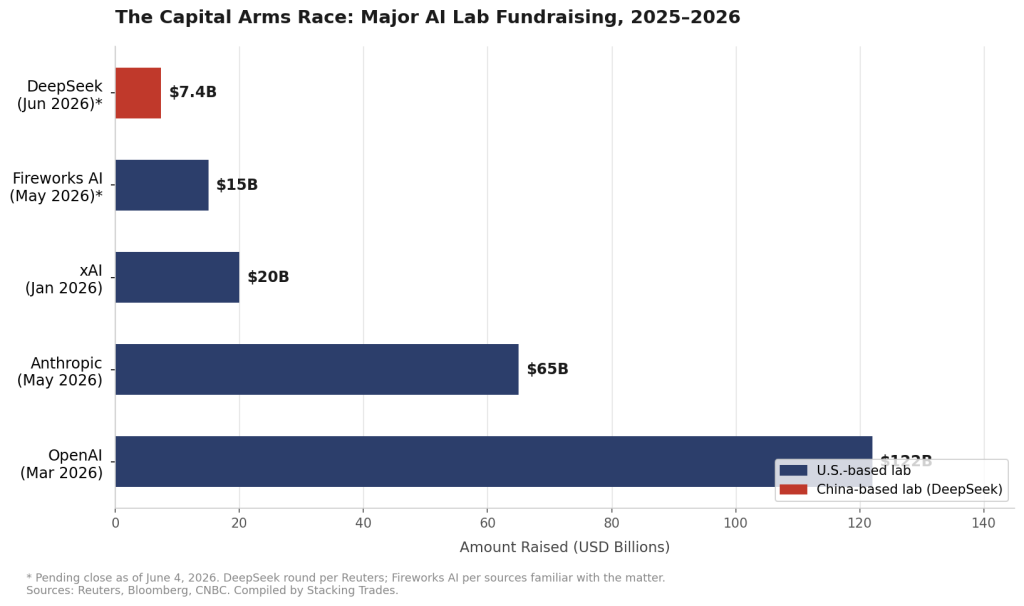
It is now over. On June 3, Reuters reported that DeepSeek is preparing to raise approximately 50 billion yuan, or $7.4 billion, in its first external funding round. Tencent and CATL are expected to be the largest outside investors, committing around 10 billion yuan and 5 billion yuan respectively. Liang himself is reportedly injecting 20 billion yuan of personal capital. IDG Capital and Monolith Capital are also among the prospective investors. The round could value DeepSeek between $52 billion and $59 billion post-money — a figure that, as recently as April, analysts were placing closer to $10 billion.
Why a Hedge Fund Can No Longer Do This Alone
The High-Flyer model was genuinely elegant. Liang built algorithmic trading infrastructure in the mid-2010s that proved directly transferable to training large language models. The compute clusters High-Flyer built for quantitative finance became DeepSeek’s early GPU backbone. When DeepSeek formally incorporated in July 2023, the capital was already in-house, the hardware was available, and the team had no obligation to any LP or VC timeline. DeepSeek trained its V3 model for a reported cost of around $5.6 million — roughly five percent of what GPT-4 cost to train — and released the weights open-source.
That efficiency story was always partly a function of constraints. DeepSeek has been blocked from accessing Nvidia’s highest-end accelerators since the U.S. expanded export controls. Its V3 model was trained on H800 chips, the first Nvidia product specifically designed to fall outside U.S. export restrictions, before those too were restricted. The V4 family, launched April 24, 2026 with 1.6 trillion total parameters across V4-Pro and V4-Flash, was optimized to run on Huawei Ascend silicon — a deliberate signal that DeepSeek is engineering around the chip supply wall rather than waiting for it to come down. NIST’s Center for AI Standards and Innovation evaluated V4’s capabilities against frontier models and found it lags the best Western closed models by approximately eight months, a narrower gap than most industry observers expected given the hardware constraints.
The problem is that closing that gap further requires compute at a scale that no hedge fund’s annual returns can sustain. Training runs at the frontier now consume infrastructure investments that make DeepSeek’s previous $5.6 million efficiency story structurally impossible to repeat. The funding round is a recognition that the physics of scale have caught up with even the most capital-efficient lab in the industry.
The $59 Billion Valuation Is a Strategic Statement, Not Just a Price
The valuation trajectory is itself the news. As recently as May, reporting placed DeepSeek’s implied valuation in the $10 to $20 billion range. The $52–59 billion post-money figure that emerged in Reuters’ June 3 reporting represents a tripling of expectations within weeks. That is not the result of a business model disclosure or revenue revelation — DeepSeek has made no public communication about its revenue, and Liang has explicitly told prospective investors the company will prioritize fundamental research over near-term commercialization. The valuation is being set entirely by strategic scarcity: there is one credible open-source AI lab operating at frontier scale outside the U.S., and investors are pricing access to it before the window closes.
The investor mix reinforces that read. Tencent and CATL are not venture capital funds making financial return calculations. Tencent needs DeepSeek proximity to stay competitive with Alibaba’s Qwen platform. CATL, primarily known as the dominant EV battery supplier, has been expanding into AI data center infrastructure, and a DeepSeek relationship gives it a demand anchor for that push. The government-backed National Artificial Intelligence Industry Investment Fund and IDG Capital are institutional signals that Beijing views this round as a strategic asset consolidation, not simply a private market transaction. The Western investor category is notably absent from all current reporting on the round.
What the No-Revenue Pitch Actually Means for Investors
Liang’s messaging to investors is unusual at a moment when every other frontier AI lab is under pressure to demonstrate a path to profit. OpenAI restructured its corporate governance and filed for a $1 trillion IPO in part to prove it can convert its 600 million user base into sustainable revenue. Anthropic raised $65 billion in May on a reported gross margin improvement to above 70%. The capital cycle that has driven AI valuations to generational extremes has been sustained, in part, by revenue and margin disclosure — something DeepSeek has systematically withheld.
Liang’s pitch is structurally different: fund us to pursue AGI and keep open-source models flowing, and the commercial return comes from being indispensable to Chinese AI infrastructure rather than from subscription revenue. That argument worked internally while High-Flyer’s returns covered the bills. It is now being tested against a roster of strategic investors who have their own board obligations, earnings calls, and competitive pressures. The question is not whether Liang means it. It is whether Tencent’s and CATL’s governance structures can hold that commitment across multiple quarters once compute costs and competitive intensity rise further.
The Hardware Wall Is the Thesis, Not the Footnote
The most important underreported dimension of this round is what DeepSeek cannot spend the capital on. Nvidia’s H100 and Blackwell architectures are both barred from export to China. The H20, a downgraded chip Nvidia designed specifically for the Chinese market, was added to the restricted list in 2025. DeepSeek’s V4 family was trained on Huawei Ascend 950PR chips, a decision that required months of software migration from Nvidia’s CUDA framework to Huawei’s CANN stack. That migration cost was, in effect, the price of hardware independence.
A $7.4 billion round going into a lab that cannot access the leading GPU architecture creates a distinct investment thesis from anything in the Western AI stack. The capital will fund Huawei Ascend infrastructure, Cambricon silicon deployment, domestic data center expansion, and the engineering talent required to optimize models for non-Nvidia hardware at scale. If that work succeeds, it validates the export control framework’s core weakness: the assumption that hardware constraints are permanent rather than workable. If it fails to close the eight-month capability gap that NIST measured, the round becomes a strategic investment in a geopolitical asset rather than a commercial technology bet — and that distinction matters to how investors should model their exit.
The round is expected to close within weeks, per Reuters. Discussions remain in flux and terms could still change. But the fact that Liang is raising at all — after three years of deliberate independence — is the answer to the question that matters most. Even the most capital-efficient lab in the world has hit the scaling wall.
What to Watch Next
- Round close confirmation and final investor list. The sub-10-investor structure means any addition of a state fund or strategic outside the current roster would shift the geopolitical read on the deal significantly. Watch for Alibaba, which has been reported as an interested party, and whether it participates despite competing with DeepSeek through its own Qwen platform.
- Huawei Ascend 950PR production capacity. DeepSeek’s ability to deploy the capital depends entirely on Huawei’s ability to manufacture chips at scale without Nvidia TSMC wafer access. Any supply constraint announcement from Huawei will directly limit DeepSeek’s compute ramp timeline.
- DeepSeek V4 stable release date. The April 24 launch carried a “preview” designation. A stable release with confirmed production readiness would be the first signal that the V4 family is generating the usage and API revenue that would eventually require commercialization disclosure to investors.
- Any SEC or CFIUS review of Western investors participating in the round. No Western institution is currently reported to be involved. If one surfaces, U.S. regulatory scrutiny of the transaction becomes a material variable for both the investor and the round timeline.
- Tencent’s next earnings commentary on AI infrastructure spend. Tencent’s AI investment posture — whether it positions the DeepSeek stake as a strategic partnership or a financial investment — will be the first public disclosure of the relationship’s commercial terms.