

Anthropic confidentially submitted its draft S-1 to the Securities and Exchange Commission on June 1, becoming the first of the major AI labs to formally begin the public-market process. OpenAI filed its own confidential prospectus on May 22, roughly ten days earlier, but disclosed nothing publicly until Anthropic’s announcement forced the wider narrative into the open. SpaceX is ten days from its June 12 Nasdaq debut. Three companies with a combined implied private-market value approaching $4 trillion are now in various stages of the same pipeline, and the order in which their public S-1s land will shape how institutional investors price all three.
The sequencing is not symbolic. Under SEC rules, a public prospectus must be filed at least 15 days before the roadshow begins. The company that files its public S-1 first sets the financial disclosure terms that every analyst covering the second company will use as their baseline. If Anthropic’s gross margins and cost structure reach the market before OpenAI’s numbers are public, Anthropic controls the comparable. If OpenAI’s audited financials land first at a September roadshow, OpenAI sets the multiple.
“This gives us the option to go public after the SEC completes its review.”
— Anthropic, official statement, June 1, 2026
The Revenue Crossover That Rewrote the Narrative
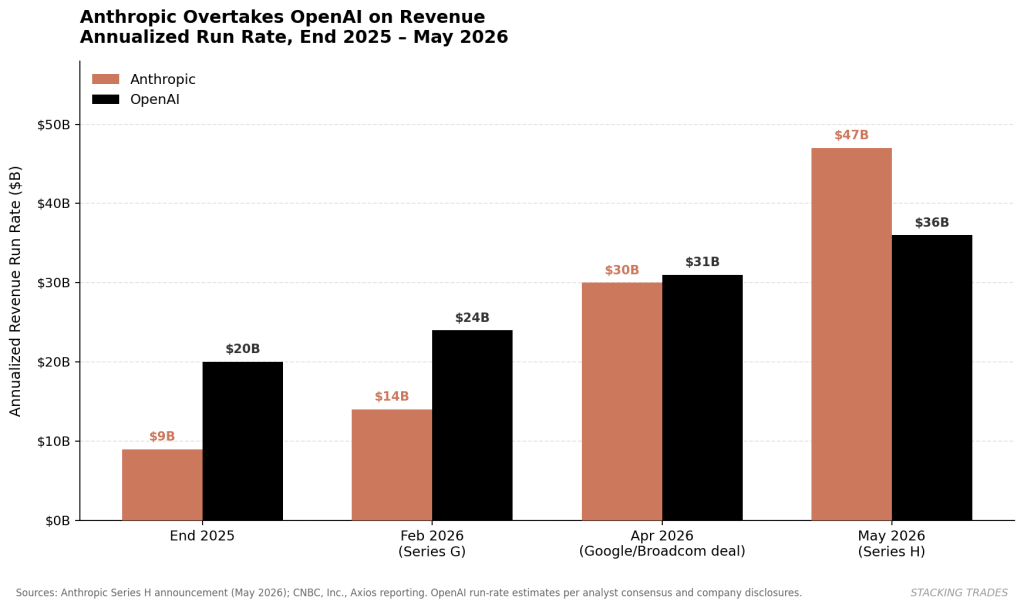
Anthropic’s Series H announcement at the end of May disclosed a revenue run rate of $47 billion, up from $30 billion in April and $9 billion at the end of 2025. That growth curve, which Inc. and CNBC both confirmed from the company’s fundraising disclosures, represents a pace with few comparables in enterprise software history. OpenAI’s run rate, by contrast, is estimated by analysts at roughly $36 billion as of May, based on the company’s reported $2 billion monthly revenue trajectory. Anthropic has publicly surpassed its primary rival on this metric for the first time.
The reversal matters for the IPO race because run-rate revenue, however imperfect as a proxy for real earnings, is how institutional allocators are currently sizing these deals. A company that enters the roadshow with a higher disclosed run rate commands the anchor comparison, and Anthropic has now built a lead it can sustain through whatever window the SEC review opens. According to CNBC, the revenue growth has been driven primarily by enterprise adoption of Claude for coding and agentic workflows, with Claude Code emerging as the product most directly responsible for the acceleration.
What the Confidential Process Conceals — and When It Stops
Both companies are currently inside the SEC’s confidential review process, which keeps audited financials, cost structures, customer concentration, and risk factors sealed from public view. For Anthropic, the most consequential number still unverified is its gross margin. The company has disclosed a run-rate improvement from roughly 38% to above 70%, a figure that has circulated in investor materials and secondary reporting. But that claim has not been tested against an audited income statement. The S-1 is where the math becomes checkable.
For OpenAI, the sealed document contains something different: loss disclosures. Multiple outlets, including Fortune and a detailed analysis citing the company’s own internal figures, have reported that OpenAI loses approximately $1.22 for every dollar of revenue generated. At a $36 billion run rate, that implies annual losses in the range of $14 billion. How OpenAI’s bankers — Goldman Sachs, Morgan Stanley, and JPMorgan Chase — frame that burn rate in the prospectus will define the risk section that every institutional allocator reads first. Sam Altman acknowledged internally, per reporting by The Information, that filing for an IPO is different from being ready to go public.
The Timeline Math Is Tighter Than It Looks
SEC review of confidential filings typically runs 60 to 90 days, with multiple rounds of comment letters. OpenAI filed May 22. That puts its earliest realistic public S-1 in late August, with a September roadshow and pricing still achievable but requiring a clean first-round review with no material accounting questions. Anthropic filed June 1. Its public S-1 could arrive as early as late August as well, if the SEC’s workload and comment calendar allow both reviews to run in parallel. The 10-day difference in filing dates may compress to near-zero by the time both prospectuses are public.
That compression sets up a scenario the market has not seen before: two companies with near-$1 trillion implied valuations releasing detailed, audited financial disclosures within weeks of each other, after a decade of operating entirely outside public reporting requirements. Axios has reported that both companies are targeting a listing window between Labor Day and Thanksgiving, and that they are working with many of the same banks. The roadshow period, when it arrives for each company, will be the first moment retail and institutional investors can access numbers that have previously been available only to late-stage private market participants.
SpaceX’s June 12 Debut Sets the Tone for Everything Else
Before either Anthropic or OpenAI reaches a roadshow, SpaceX prices on June 12. The deal is targeting up to $75 billion at a valuation of $1.75 to $1.8 trillion, which would make it the largest IPO in history. Its first-day trading performance and the quality of the institutional order book will function as a real-time stress test of whether public markets in 2026 will absorb technology companies at these multiples. A strong open confirms that the rate environment and investor appetite can support what comes next. A soft open compresses the September window for OpenAI and could push Anthropic into Q4 or beyond, regardless of how clean its SEC review process turns out to be.
The 10-year Treasury yield, which touched 4.6% during May’s bond-market volatility, is the rate variable the underwriters are watching most closely. The June 16-17 FOMC meeting under Chair Kevin Warsh will be the first policy signal in the post-SpaceX pricing environment. Any language suggesting rate hikes are back under consideration would immediately reprice the revenue-multiple math that all three valuations depend on. At 95 times revenue and a net loss, these are not interest-rate-neutral deals.
The Comparable Problem Neither Company Wants
Once both prospectuses are public, analysts will have, for the first time, two directly comparable AI frontier-lab financials to work from. That comparison will not favor whichever company has the weaker gross margin, higher customer concentration, or less defensible cost structure. Both companies have operated for years with the benefit of no public comparable. The SpaceX prospectus has already disrupted that dynamic at the infrastructure layer. Anthropic’s and OpenAI’s S-1s will do it at the model layer, and neither company controls how that comparison lands once the numbers are visible side by side.
The sequencing race is really a narrative race. Filing first, disclosing stronger unit economics, and pricing into a stable rate environment are the three variables that determine which company walks away from the fall IPO window having set the terms. Anthropic moved on June 1 to make sure it has a shot at all three.
What to Watch Next
- SpaceX first-day trading, June 12. Institutional appetite at the open and the closing price relative to the $1.75–$1.8 trillion anchor will be the most direct signal of whether the rate environment can support the two AI IPOs that follow.
- The FOMC meeting, June 16-17. Chair Warsh’s first statement as Fed chair. Any language reintroducing rate-hike risk would immediately reprice the revenue multiples underpinning both AI listings and could force timeline slippage into Q1 2027.
- Anthropic’s public S-1 on SEC EDGAR. The audited gross margin figure is the single most consequential number in the filing. Whether it confirms or revises the reported 70%-plus improvement from 38% will reset private-market valuations across the AI sector the day it publishes.
- OpenAI’s public S-1 and loss disclosure framing. How Goldman Sachs, Morgan Stanley, and JPMorgan structure the burn-rate narrative — particularly whether they position current losses as a short-term infrastructure investment or a structural characteristic of the business — will determine the multiple institutional investors will accept.
- The order of roadshows. If Anthropic begins its roadshow before OpenAI’s S-1 is public, Anthropic controls the sector valuation conversation. If OpenAI prices first, it sets the comparable Anthropic’s bankers must defend. Watch for any underwriter communication that signals which company intends to move faster through the SEC comment process.