

Google shipped Gemini 3.5 Flash on May 19 at its annual I/O developer conference, and the benchmark numbers are doing something unusual: they show a Flash-tier model outperforming its own flagship on the tasks enterprise software teams actually care about. That’s not a product positioning move. It’s a pricing signal, and it lands at a moment when every large company running AI workloads at scale is actively reconsidering what they’re paying for.
The headline from the launch is speed — Google says 3.5 Flash runs four times faster on output tokens per second than comparable frontier models. But the more consequential claim is the agentic performance data. On Terminal-Bench 2.1, the benchmark most closely aligned with autonomous coding tasks, 3.5 Flash scores 76.2%, edging ahead of Gemini 3.1 Pro’s 70.3% and trailing only GPT-5.5 at 78.2%. On MCP Atlas, which tests multi-step tool coordination, it leads the field at 83.6%. The model that costs roughly 25% less than its predecessor is beating that predecessor where it matters most for production deployments.
“It’s clear we’re firmly in our agentic Gemini era.”
— Sundar Pichai, CEO, Google/Alphabet, Google I/O Keynote, May 19, 2026
What the Benchmarks Actually Measure
Terminal-Bench 2.1 tests a model’s ability to operate a computer through a terminal — executing multi-step tasks, using tools, and recovering from failures without human intervention. MCP Atlas evaluates deterministic tool orchestration across complex, multi-agent pipelines. These are not academic exercises. They are close proxies for the workloads enterprise engineering teams have been piloting for the past 18 months: automated code review, CI/CD pipeline agents, and customer-facing software that needs to take action rather than just generate text.
Where 3.5 Flash gives ground is on pure reasoning benchmarks. It scores 72.1% on ARC-AGI-2, which tests novel pattern recognition, versus 77.1% for Gemini 3.1 Pro. On Humanity’s Last Exam, it trails Pro 40.2% to 44.4%. Those gaps matter if your use case involves hard scientific reasoning or PhD-level knowledge synthesis. They matter less if your use case involves agents completing structured work across connected software systems — which describes the majority of enterprise agentic deployments currently generating revenue.
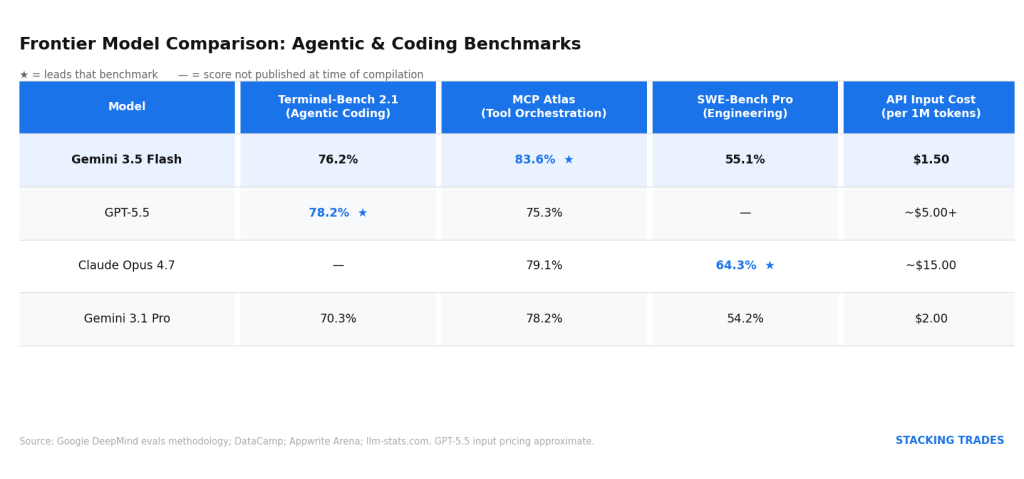
The SWE-Bench Pro result tells a more nuanced story. At 55.1%, 3.5 Flash narrowly beats Gemini 3.1 Pro’s 54.2%, but Claude Opus 4.7 leads that benchmark at 64.3% — a gap large enough that any team prioritizing production-quality software engineering at the repository level has a real reason to stay on Anthropic’s platform. The benchmark data does not produce a universal winner. It produces a routing map.
The Cost Argument Is the Real Story
Gemini 3.5 Flash is priced at $1.50 per million input tokens and $9.00 per million output tokens. Gemini 3.1 Pro runs $2.00 input and $12.00 output. GPT-5.5 is positioned considerably higher. Claude Opus 4.7 input costs roughly ten times what 3.5 Flash charges per token.
Google made the enterprise math explicit at I/O. The company’s stated claim: organizations processing around one trillion tokens per day could save over $1 billion annually by shifting 80% of workloads from other frontier models to 3.5 Flash. That figure is directionally plausible even if it requires assumptions about current provider mix and workload composition. For the chief technology officer reviewing an AI infrastructure budget line that has compounded sharply over the past two years, the sentence is hard to sit with unchallenged.
The switching cost argument has always been the counterweight to price competition in enterprise AI. Prompt engineering, fine-tuning, evaluation pipelines, and production integrations are genuinely expensive to migrate. But 3.5 Flash supports the same 1 million token context window and full multimodal inputs as its predecessors, and it runs on the same API surface developers are already using. For teams that have not built deep model-specific optimization, the migration calculus is lighter than it was a year ago.
Where the Independent Data Is Sparse
One important caveat: most of the headline benchmark numbers for Gemini 3.5 Flash come from Google’s own evaluation methodology. Independent validation from third-party organizations like Epoch AI or ARC Prize was not available at the time of this writing. The 78% SWE-Bench Verified figure — slightly different from the SWE-Bench Pro numbers — is the one score that reviewers have been able to corroborate against the benchmark maintainer’s public leaderboard. The agentic suite numbers are self-reported.
That is not unusual. Most model launches arrive with proprietary benchmark packages before the research community has produced independent evaluations. But it does mean enterprise procurement teams evaluating a migration should treat the MCP Atlas and Terminal-Bench numbers as directional claims, run their own internal evals on representative production workloads, and wait for Artificial Analysis or comparable independent benchmarkers to publish results before making irreversible platform decisions.
The Strategic Frame Is Bigger Than the Model
Gemini 3.5 Flash did not launch in isolation. At I/O 2026, Google simultaneously announced Gemini Spark — a 24/7 background agent that executes workflows across Gmail, Docs, Salesforce, and ServiceNow — and the Gemini Enterprise Agent Platform, a full-stack management layer for organizations running agent fleets at scale. The model launch and the enterprise platform launch are the same pitch: Google is not selling a better API. It is selling a vertically integrated AI operating layer, with Gemini 3.5 Flash as the inference engine running inside it.
That context matters for how to interpret the pricing. Cutting token costs 25% while outperforming a more expensive flagship on agentic benchmarks is a credible stand-alone value argument. But Google’s actual target is the enterprise software budget sitting behind the API bill — the Salesforce renewals, the ServiceNow contracts, the Microsoft 365 seat counts — all of which become easier to defend or harder to justify depending on whether the incumbent AI layer is outperforming Google’s stack on the tasks employees actually run. The enterprise software renewal cycle has become the most consequential battlefield in the AI platform war, and Gemini 3.5 Flash is Google’s most targeted weapon in that fight so far.
The model that earns the most revenue in enterprise AI is not the one that scores highest on every benchmark. It is the one that runs reliably enough, cheaply enough, and broadly enough to become the default infrastructure choice before competitors lock in the next contract cycle. Google’s 3.5 Flash is an explicit attempt to claim that position before OpenAI’s IPO — and the enterprise customer conversations it will generate — resets the room.
What to Watch Next
- Independent benchmark validation from Epoch AI, Artificial Analysis, or ARC Prize for Gemini 3.5 Flash’s MCP Atlas and Terminal-Bench 2.1 scores. Self-reported results are the current baseline; independent confirmation or revision will be the first real pricing signal for enterprise procurement teams evaluating a migration.
- Gemini 3.5 Pro release timeline. Google confirmed the Pro variant is in internal use and slated for the following month. Its benchmark profile — and whether it closes the gap with Claude Opus 4.7 on SWE-Bench Pro — will determine whether the 3.5 family is competitive at the top of the market, not just in the mid-tier routing decision.
- GitHub Copilot and Cursor adoption data for Gemini 3.5 Flash. Both platforms integrated the model at launch. Any developer survey or usage disclosure from either company through Q3 will be the first real-world signal on whether 3.5 Flash’s agentic benchmark advantage translates into production coding agent adoption at scale.
- OpenAI’s response. The company has not formally repositioned a product against 3.5 Flash’s pricing tier. Any announcement of a GPT-5.5-class model at a comparable or lower token cost would directly narrow the cost gap Google is using as its primary enterprise argument.
- Google Cloud Q2 2026 results. Alphabet reports in late July. Enterprise AI paid user growth and any Gemini Enterprise Agent Platform adoption commentary will show whether I/O 2026’s agentic positioning is converting to commercial contracts or remaining a developer-layer story with a longer enterprise sales cycle ahead of it.