



The stock move was fast and nearly uniform. Within an hour of the Wall Street Journal’s report on May 21, Rigetti Computing had jumped 15%, D-Wave was up more than 17%, and IonQ had gained 8%. IBM rose 6%. The Philadelphia Semiconductor Index barely moved. The market had just absorbed news that the Trump administration, through the Department of Commerce, was committing $2.013 billion in CHIPS Act incentives to nine quantum computing companies — and investors bought first and read second.
That sequencing matters. Because what the market priced in the first session and what the announcement actually contains are not the same thing.
Letters of Intent Are Not Contracts
The Department of Commerce was careful about its language. The agency announced the signing of nine letters of intent — a standard pre-award step that initiates a due diligence and negotiation process before any funds change hands. LOIs are not disbursement orders. They are the beginning of a process that includes compliance review, final term negotiation, and, in some cases, Congressional notification requirements. The CHIPS Act semiconductor awards that preceded these quantum grants — including the Intel deal announced in August 2025 — went through months of negotiation between LOI signing and final agreement execution. There is no disclosed timeline for when these quantum LOIs convert to binding agreements.
That is not a reason to dismiss the announcement. The policy signal is real: the U.S. government has formally designated fault-tolerant quantum computing as a strategic infrastructure priority, extended the CHIPS Act industrial policy model to an entirely new sector, and named nine specific technology approaches worth backing. That has lasting implications for the companies involved and for the broader competitive dynamic with China. But it is a different thing from nine companies receiving $2 billion in cash.
“With today’s CHIPS Research and Development investments in quantum computing, the Trump administration is leading the world into a new era of American innovation.”
— Howard Lutnick, Secretary of Commerce, Department of Commerce press release, May 21, 2026
The Equity Stake Provision Is the Part Worth Understanding
Every one of the nine awards includes a government equity stake as a condition of funding. This is the same structure applied to the Intel CHIPS award last year — a model the administration has now explicitly extended beyond semiconductors into quantum hardware. For sophisticated investors, the equity provision changes the ownership math in ways that weren’t priced into the session-day spike.
A government equity position means dilution for existing shareholders, the creation of a new class of stakeholder with no profit motive and potentially different priorities, and the introduction of ongoing disclosure and compliance obligations tied to the award terms. The specific stake sizes and governance rights have not been disclosed for any of the nine recipients. Until the LOIs convert to final agreements — and the terms of those agreements are made public — the equity provision is an open variable sitting inside a valuation that moved 15–17% in a single session on incomplete information.
The Portfolio Deliberately Avoids Picking a Winner
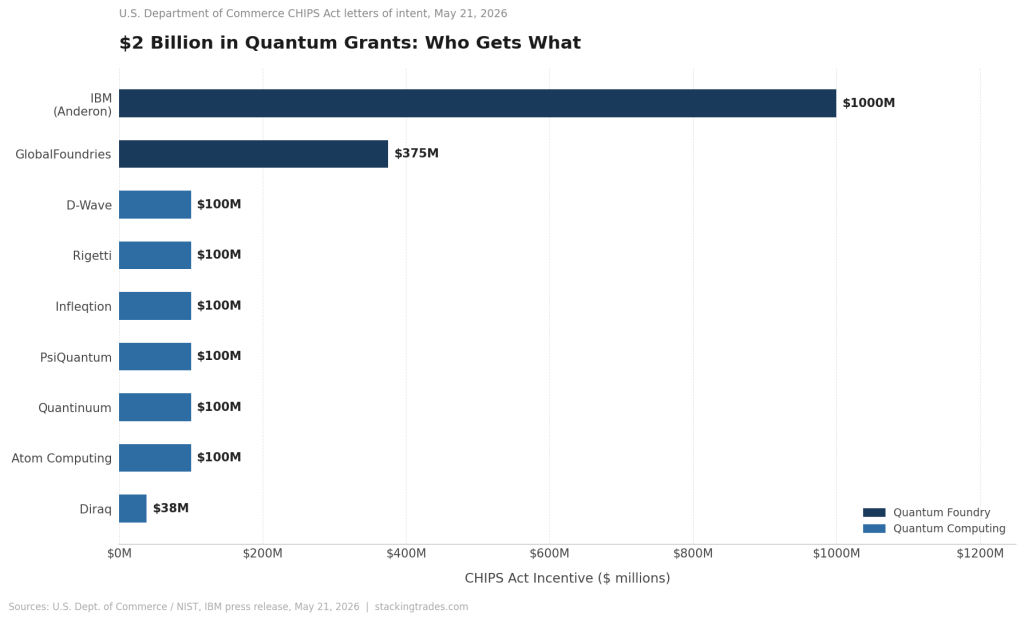
The nine recipients span nearly every viable approach to quantum computing that exists today. IBM and Rigetti pursue superconducting qubits. D-Wave operates quantum annealing systems — a fundamentally different architecture that is the only approach currently running enterprise applications in production at meaningful scale. Quantinuum works with trapped-ion technology. Atom Computing and Infleqtion develop neutral-atom systems. PsiQuantum builds photonic quantum processors. Diraq is developing silicon-spin qubits using standard CMOS fabrication lines, which, if it works at scale, could be the most manufacturable approach of any on the list.
IBM anchors the portfolio with a $1 billion commitment to build Anderon, a new standalone subsidiary described as America’s first pure-play quantum wafer foundry. GlobalFoundries receives $375 million to establish a multi-modality quantum foundry covering superconducting, trapped-ion, photonic, topological, and silicon-spin architectures. The foundry layer is the strategic bet beneath all the others: without domestic manufacturing infrastructure for quantum-grade superconducting wafers, every other approach on this list eventually hits a supply chain dependency. The government is trying to solve the whole stack, not just fund the most visible names.
D-Wave Is the Outlier in This Group — and That Is Worth Noting
Most of the seven quantum computing recipients are research-stage companies with limited or no commercial revenue. Rigetti reported $7.1 million in full-year 2025 revenue against a GAAP net loss of $216 million. IonQ, the largest of the publicly traded names by market capitalization, generated $110 million in 2025 revenue — meaningful, but still heavily weighted toward government contracts and research institutions rather than enterprise commercial deployments at scale.
D-Wave stands apart. The company reported $24.6 million in 2025 revenue, up 179% year-over-year, with more than 135 paying customers including over two dozen Forbes Global 2000 enterprises using its annealing systems in production. That is not a lab experiment. D-Wave’s annealing architecture is architecturally distinct from the gate-model systems most of its co-recipients are building toward, and the $100 million grant it received is the same size as Rigetti, Quantinuum, and Infleqtion — companies with fundamentally different revenue profiles. The government’s equal-weight treatment of companies at very different stages of commercial maturity is a deliberate hedge, not a performance ranking. Investors who interpreted the uniform move in quantum stocks as a uniform validation of all nine companies were reading the announcement incorrectly.
The China Context Is the Real Driver
The announcement’s geopolitical framing was not incidental. Commerce Secretary Lutnick’s statement emphasized American leadership and domestic industry explicitly, consistent with the administration’s broader posture on strategic technology competition. China has made quantum computing a national priority under its 14th and 15th Five-Year Plans, with state investment in quantum research estimated to exceed U.S. levels on a sustained basis since 2021. The CHIPS Act quantum awards are designed to do what the semiconductor awards were designed to do: establish domestic manufacturing infrastructure for a technology the government has decided it cannot afford to import.
For private market investors, the quantum grant structure also raises a question that extends beyond this announcement. If the CHIPS Act model — government grant plus equity stake, conditioned on domestic production and supply chain requirements — becomes the standard path for quantum hardware companies to reach commercial scale, it changes the return profile for early venture investors in these companies. A government co-investor with a minority equity stake and compliance strings attached is a different thing from a clean cap table. That conversation has barely started.
What to Watch Next
- LOI conversion timelines for each of the nine recipients. The CHIPS Act semiconductor awards took months to move from LOI to final agreement. Watch for any Commerce Department disclosure of a review schedule — that will set the timeline for when these incentives become binding.
- Government equity stake terms when disclosed. The specific stake sizes, governance rights, and exit provisions have not been published. When they are, the dilution math for existing shareholders in Rigetti, D-Wave, and IonQ becomes calculable for the first time.
- IBM Anderon capitalization structure. IBM said it expects outside investors to join as Anderon scales beyond the initial $2 billion commitment. A foundry that manufactures quantum-grade superconducting wafers for multiple architecture types — and that carries government backing — could attract strategic investment from every company on the recipient list.
- D-Wave Q1 2026 results and bookings trajectory. The company entered 2026 with over $32.8 million in post-year-end bookings already closed. First-quarter results will show whether its commercial momentum is accelerating ahead of, or independent from, the government grant runway.
- China’s response. Watch for any accelerated procurement announcements from Beijing targeting quantum hardware companies in Europe, Australia, or Canada — particularly PsiQuantum, which is Australian-founded — as the U.S. moves to lock in domestic supply chain relationships.