

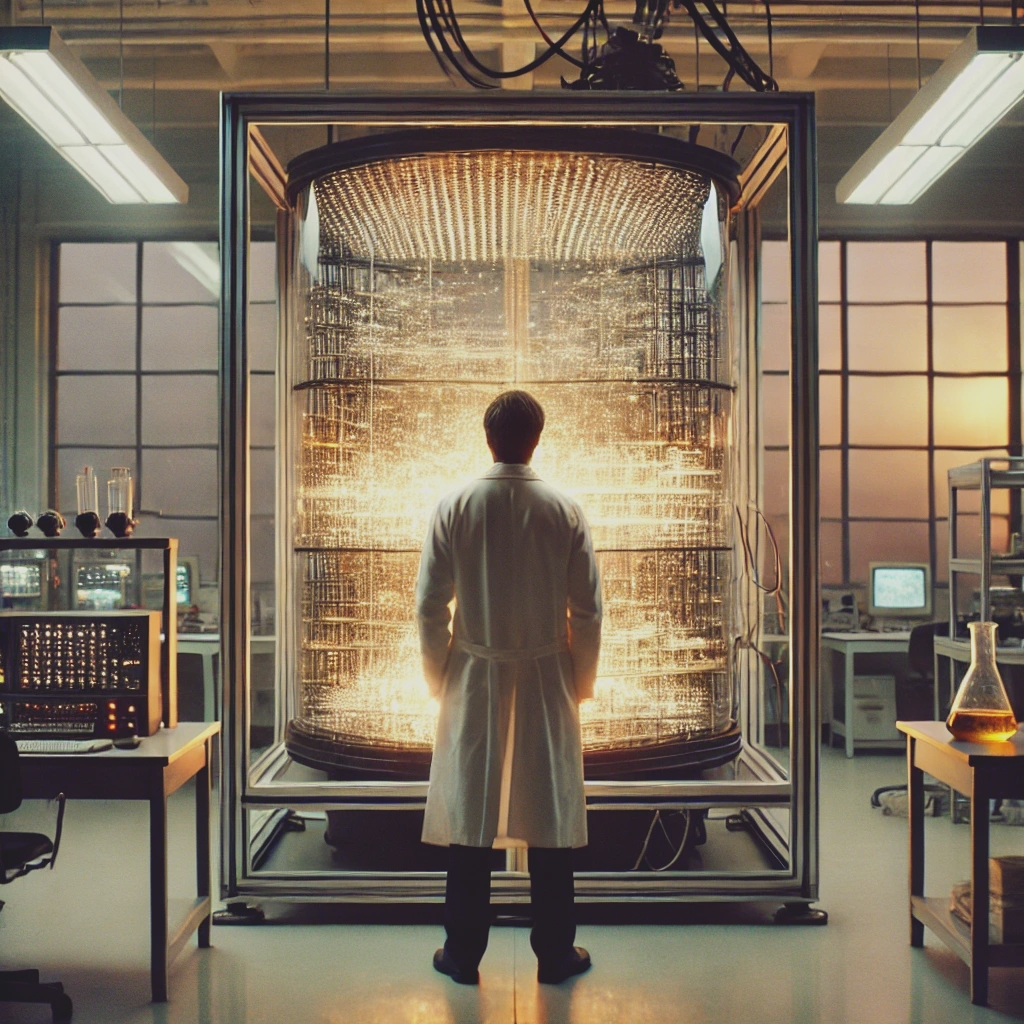
Where Simulations Discover Before We Do
For as long as we can remember, the hardest part of science was running the experiment.
Now, increasingly, the hardest part is remembering that the experiment isn’t real.
Across labs, universities, and private AI institutes, a new branch of inquiry is emerging: synthetic reality research — the study of data, environments, and outcomes that exist nowhere in the physical world but behave as if they do. Scientists are beginning to publish findings drawn from simulations so vast and nuanced that, in practice, they feel like nature itself.
We’re witnessing the birth of an epistemological shift: a world where truth can be observed without ever touching it.
The Lab With No Walls
In traditional science, knowledge moves at the speed of matter. You mix chemicals, breed organisms, or test thousands of samples and then wait to see what reality allows. In synthetic labs, reality is software. Researchers don’t test one hypothesis at a time — they generate a universe and watch how patterns emerge.
A biology group in Cambridge now runs a virtual ecosystem of 10 billion digital microbes. Climate scientists train atmospheric models that simulate centuries of storms before lunchtime. Economists run economies that exist only inside models — and some of those economies crash, recover, and invent currencies faster than ours ever could.
The experiment isn’t in a Petri dish anymore.
It’s in a parallel dimension of probability.

When Fiction Becomes a Research Method
What’s fascinating — and unnerving — is how believable these worlds have become. The line between simulation and observation is blurring. Researchers talk about “synthetic discovery” — insights born entirely inside generated data that are later verified in the real world.
Last year, a protein-folding algorithm predicted the structure of enzymes that didn’t yet exist — until chemists created them months later, almost exactly as modeled. The discovery technically happened twice: once virtually, and the second time physically.
It raises a subtle question: When does simulation stop being imitation and start being reality?
The Ethics of the Imagined
Synthetic research also scrambles how we think about responsibility.
If an AI-trained climate model runs ten thousand versions of a hurricane and discovers that half of them devastate coastal cities, who bears the moral weight of that knowledge?
Do we treat the unreal storm as a warning — or as fiction?
And what happens when synthetic models start producing results that are useful but unverifiable? A medical AI might simulate ten million drug interactions and find an optimal one that hasn’t — and might never — exist. Do we raise money to make its synthesis possible, or archive it as fantasy?
The more convincing our fabrications become, the less we can separate what’s probable from what’s possible.
“We’ve built a mirror universe that talks back.”
The Mirror of Reality
Philosophers used to debate whether mathematics was discovered or invented.
Synthetic research revives that tension in the era of machine intelligence.
Because the moment our models can invent testable phenomena, “real” becomes a spectrum. There’s the physical world, and then there’s the one we simulate until it behaves truthfully enough to count.
For the first time, humanity is building a mirror universe that talks back — an environment that produces knowledge before actual experience does.
It’s a leap forward for science, but also a quiet existential moment.
We’ve always assumed understanding the world required touching and witnessing it.
Now we can simulate understanding itself.
The Future of Knowing
Some of the most advanced labs are no longer optimizing models — they’re optimizing reality generators. Tools that not only imitate data but invent new categories of phenomena to study.
Imagine future fields like:
• Synthetic Epidemiology, where pandemics play out inside algorithms instead of human populations.
• Virtual Cosmology, where new universes are spun from physics equations that our own universe forbids.
• Counterfactual History, where AI runs centuries of “what-if” political timelines to test social theories.
At that point, science becomes partly storytelling — except the story learns back.
A New Definition of Real
Synthetic reality research doesn’t replace physical science. It reframes it.
It asks: if a model can replicate the world so precisely that it predicts new truths, does it matter whether it “exists”?
Reality is no longer a prerequisite for understanding — it’s a validation step.
And that changes everything.