

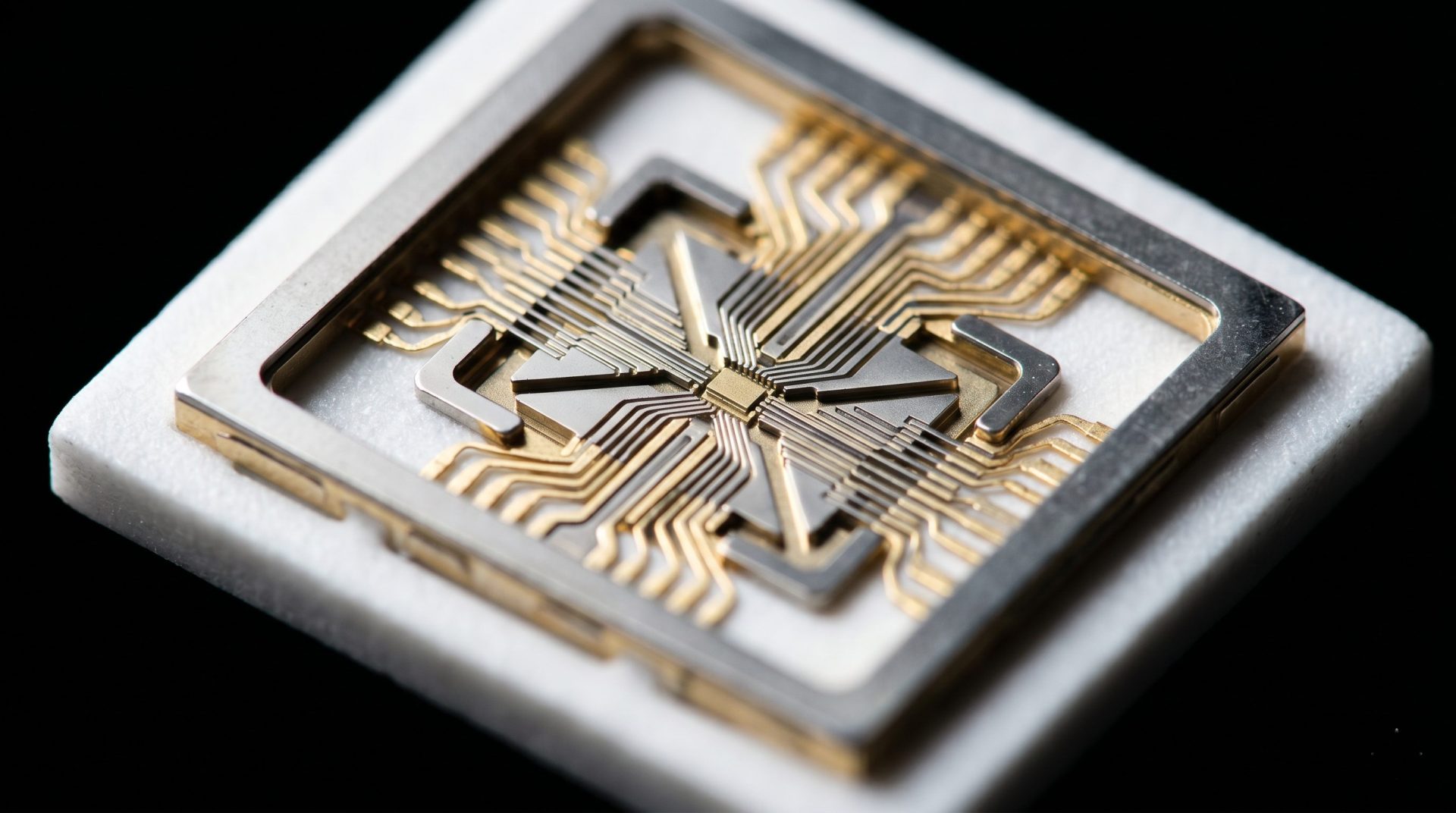
On Tuesday, Quantinuum set terms for its Nasdaq IPO: 21.05 million shares at $45 to $50 each, targeting up to $1.05 billion in proceeds at a valuation ceiling of $12.7 billion. The company generated $30.9 million in revenue in 2025, reported a net loss of $192.6 million for the same year, and posted $5.2 million in revenue in the first quarter of 2026 — down 73% from the prior-year period — while its quarterly loss widened to $136.6 million. At the top of the IPO range, investors are being asked to pay approximately 411 times trailing twelve-month revenue for a company whose best-known commercial system, Helios, has 98 physical qubits and whose next major platform, Apollo, is not expected until 2029.
The multiple is not a rounding error. It is the explicit market price for the belief that trapped-ion quantum computing will become commercially meaningful before the end of the decade, and that Quantinuum — specifically, not its better-funded competitors — will be the company that captures the value when it does. Both propositions deserve scrutiny before the roadshow closes.
What the S-1 Actually Discloses
The prospectus, filed with the SEC on May 8, is unusually candid about where the company stands commercially. Quantinuum’s customers are engaging with its systems primarily through “exploratory, research-driven or pilot programs, rather than long-term production deployments,” the filing states. The company has accumulated a deficit of approximately $1.5 billion since inception and has invested roughly $2 billion in research and development across its predecessor organizations over the past decade. The $79.3 million in bookings disclosed for 2025 represents signed customer agreements that may convert into future revenue, not recognized revenue — and the gap between bookings and recognized revenue in Q1 2026 is stark.
Honeywell will retain roughly 49% of the votes after the offering. Founding shareholders Honeywell and Cambridge Quantum Holdings together will hold approximately 82% of equity post-IPO. That concentration means the public float is relatively thin, and it means existing HON shareholders do not automatically receive QNT shares — direct quantum exposure requires participating in the IPO or buying on the secondary market after listing.
“We believe that we are executing a roadmap to the first commercial-scale, fully fault-tolerant quantum computer before the end of this decade, the Apollo system.”
— Rajeeb Hazra, President and CEO, Quantinuum, Letter to Investors, S-1 Prospectus, May 2026
The technical pitch rests on accuracy rather than qubit count. Quantinuum’s ion-trap architecture — which uses charged atoms held in electromagnetic fields as qubits rather than the superconducting circuits used by most rivals — delivers what the company claims is industry-leading gate fidelity: 99.921% on two-qubit operations for the Helios system. The argument is that fewer, higher-quality qubits running more reliable operations can outperform architectures with larger raw qubit counts. Whether that holds at the scale required for commercially useful applications is the question the Apollo roadmap is supposed to answer by 2029.
The Peer Comparison Nobody Wants to Sit With
Quantinuum is pricing into a public quantum sector that has rebounded sharply from its March lows. IonQ is up roughly 132% since the end of March. D-Wave is up approximately 110%. Rigetti and Quantum Computing Inc. are both up more than 85% over the same period. The rally has made the sector look healthy in isolation. The revenue comparison makes it look considerably less straightforward.
IonQ reported $130 million in full-year 2025 revenue — more than four times Quantinuum’s figure — and guided to between $260 million and $270 million for 2026 after posting $64.7 million in Q1 alone. IonQ’s implied price-to-sales multiple, at roughly 77 times trailing revenue, is aggressive by any conventional measure. Against Quantinuum at 411 times, it looks almost conservative. The investor who chooses Quantinuum over IonQ is not just making a bet on quantum computing — they are making a more specific bet that Quantinuum’s architecture and software stack will prove more durable than IonQ’s commercial momentum, despite IonQ having more than four times the current revenue base and a clear near-term growth trajectory. That is a defensible position, but it requires a framework that goes well beyond the S-1 financials.
The structural difference is that Quantinuum took the traditional IPO route rather than the SPAC path that brought most public quantum names to market. J.P. Morgan and Morgan Stanley are joint lead bookrunners. That combination of institutional underwriting and Honeywell’s balance sheet backing gives the deal a different profile from the earlier generation of quantum listings. It also means the institutional allocation process will be a genuine signal: if the book fills well at the $45 to $50 range, it indicates that sophisticated long-only capital is willing to hold a 400x revenue multiple on a research-stage asset. That has implications beyond Quantinuum.
The Government Backstop and What It Actually Covers
The timing of this IPO is not coincidental. On May 21, four days before Quantinuum set its pricing terms, the Trump administration announced more than $2 billion in Commerce Department funding for a group of U.S. quantum computing firms. IBM received the anchor award at $1 billion to build Anderon, a domestic quantum wafer foundry. Quantinuum is set to receive up to $100 million, structured through a non-binding letter of intent under the CHIPS Act, to be disbursed in tranches tied to specific technical milestones: developing low-loss integrated photonics, prototyping control chips for cryogenic operation, and packaging optical components for trapped-ion systems.
The government backstop matters, but the S-1/A is explicit that it is not yet finalized. In exchange for the funding, Quantinuum will issue equity securities to the Department of Commerce on the award date — dilutive to public shareholders, though the precise stake size has not been publicly disclosed. The funding is milestone-gated, not guaranteed, and the letter of intent is non-binding. Investors who are pricing the government relationship as a firm commitment rather than a conditional one are reading a different document than the one filed with the SEC.
What Pricing Day Will Actually Test
Quantinuum is not the only large, technically ambitious IPO landing in the first half of June. SpaceX is targeting June 12. The book-build for a $75 billion raise at a $1.75 trillion valuation is running simultaneously with Quantinuum’s $1.05 billion roadshow. The capital allocation question — whether institutional investors have the appetite and the mandate to participate in both — is real, though Quantinuum’s much smaller raise means it is unlikely to be directly crowded out by SpaceX demand.
The more relevant test is what first-day trading communicates about sector pricing. Quantinuum will likely be the first quantum computing company to price via a traditional IPO with full institutional bookrunner involvement. How the stock opens relative to the $45 to $50 range, and whether it holds above issue price in the first week of trading, will set the reference point for how public markets are currently willing to value the quantum computing category. That has direct implications for IonQ’s multiple, D-Wave’s recovery, and — less obviously — for any private quantum company that has been using the public sector’s rebound to support its own valuation narrative in secondary markets.
The BCG Quantum Forecast cited in Quantinuum’s own prospectus projects $5 to $10 billion in end-user value from quantum computing by 2030, scaling to up to $850 billion by 2040. The IPO is priced on the assumption that investors believe the 2040 number, are willing to pay for it in 2026, and have concluded that Quantinuum — over IonQ, over IBM’s quantum division, over Google’s Willow program — will be the platform that captures a meaningful share of it. That is the bet on the table. The roadshow will show how many institutional investors are prepared to take it at 411 times trailing revenue.
What to Watch Next
- Quantinuum’s first-day trading relative to the $45 to $50 pricing range. An opening above issue price with institutional-driven volume confirms that long-only capital is willing to hold 400x-plus revenue multiples in the quantum sector. A first-day dip or flat open signals that even with Honeywell backing and government endorsement, the market found the multiple too rich — which would immediately pressure IonQ and D-Wave valuations and complicate any private quantum company using the sector rally in secondary pricing.
- The CHIPS Act award definitive agreement. The non-binding LOI for $100 million remains unsigned. Watch for Commerce Department confirmation of a final award date; the equity dilution terms — currently undisclosed — will become calculable for public shareholders only after the definitive documents are filed. The milestone structure (photonics fabrication, ASIC prototyping) will also reveal Quantinuum’s technical execution timeline in more granular terms than the S-1 roadmap provides.
- IonQ Q2 2026 results, expected early August. IonQ guided to $65 to $68 million in Q2 revenue after posting $64.7 million in Q1. If IonQ delivers again at or above the midpoint of guidance, the company will have logged more revenue in the first half of 2026 than Quantinuum generated in all of 2025 — a comparison that will become harder to ignore as analysts recalibrate relative valuations across the public quantum sector post-IPO.
- Quantinuum’s Sol system disclosure timeline. The prospectus targets Sol, the generation after Helios, for 2027. Any technical delay announcement, partner-access preview, or early performance specification will serve as the first real-world signal on whether the 2027 milestone is tracking — and whether the Apollo 2029 target remains credible.
- SpaceX first-day performance on June 12 and its downstream effect on IPO risk appetite. If SpaceX prices at or above $1.75 trillion and opens strong, it validates the broader thesis that public markets in 2026 will absorb large, pre-profitability technology listings at premium valuations. That would benefit Quantinuum’s secondary-market trading and extend the window for OpenAI’s September roadshow. A SpaceX stumble compresses all three timelines simultaneously.