


Regulation Crowdfunding has never been short on ambition. When Congress created the exemption under the JOBS Act, the idea was straightforward: let ordinary Americans invest in early-stage companies the same way venture capitalists do, with proper disclosure and guardrails built in. What followed was a decade of incremental progress, regulatory friction, and a funding cap that kept getting in the way.
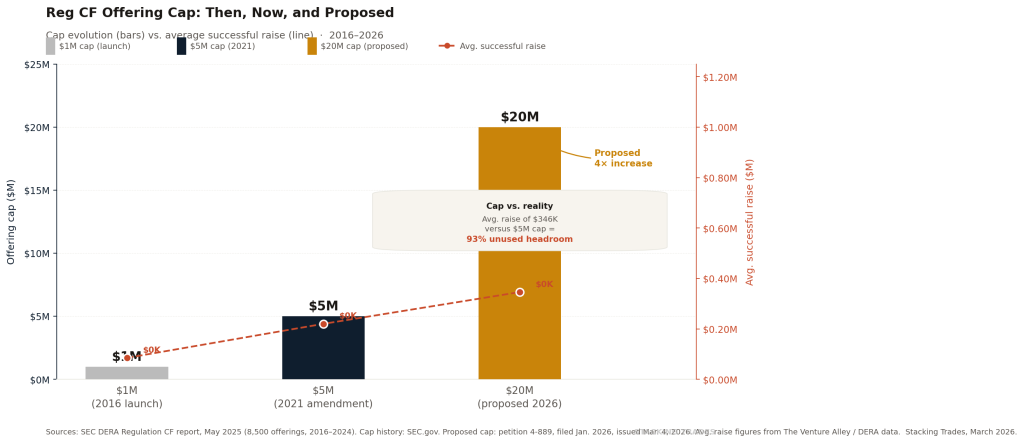
A formal petition is now on file with the SEC to raise the Reg CF funding cap from $5 million to $20 million. Filed as petition number 4-889 and issued March 4, 2026, it is the most substantive push for Reg CF reform since the last cap increase — and it arrives at a moment when the crowdfunding industry is posting its best annual numbers ever while facing structural questions about its long-term competitiveness.
How the Cap Became a Problem
Reg CF originally set a funding cap of $1 million — widely criticized as too low for meaningful capital formation. The SEC raised it to $5 million in March 2021, which opened the exemption to a broader range of issuers. That change helped: Reg CF raised $378.3 million in 2025, while Reg A+ surged 124% to $546.6 million, bringing combined investment crowdfunding to $924.8 million for the year.
But the $5 million ceiling has increasingly become a binding constraint for the segment of issuers the exemption is best suited to serve. In a letter to SEC Chairman Paul Atkins, Crowdfund Capital Advisors founder Sherwood Neiss argued that the current cap “fragments otherwise efficient capital raises into multiple offerings without providing commensurate investor-protection benefits.”
The fragmentation problem is real. A company that needs $8 million to reach its next milestone has no clean path under Reg CF. It either caps out at $5 million and leaves money on the table, layers in a separate Reg D raise for accredited investors, or migrates entirely to Reg A+ — a more burdensome exemption designed for larger, more established companies. None of those options is clean, and all of them add cost and complexity for founders who chose Reg CF precisely because it is the most accessible exemption.
Why $20 Million, Not $10 Million
Neiss argued that a modest increase to $10 million risks recreating the same inefficiencies, noting that issuers raising between $10 and $20 million tend to be post-revenue and more mature — meaning lower risk profiles that justify expanded access. Under the proposal, the cap would also be indexed to inflation going forward, eliminating the need for future regulatory action to keep pace with market realities.
The $20 million figure maps directly to Reg A+ Tier 1, which already allows offerings up to $20 million. Reg A+ Tier 2 allows up to $75 million with audited financials and ongoing reporting requirements — a much heavier compliance lift than Reg CF demands. Setting the new Reg CF cap at $20 million would create a more logical continuum across the exempt offering framework, reducing the pressure on issuers to thread between exemptions mid-raise.
“Regulation Crowdfunding has brought more transparency to early-stage investing than almost any other exemption. Raising the cap builds on that success rather than pushing issuers into workarounds.”
—Sherwood Neiss, Crowfund Capital Advisors, petition letter to SEC Chairman Paul Atkins, January 2026
What the Data Actually Shows About Reg CF Issuers
Before getting too far ahead, it is worth understanding who currently uses Reg CF. SEC DERA data covering 2016 through 2024 found that the median issuer had approximately $80,000 in total assets, median revenue of $10,000, and employed three people. Between 2016 and 2024, roughly 8,500 crowdfunding offerings were initiated by around 7,000 issuers — and approximately 60% of all attempted Reg CF offerings raised nothing.
The average successful offering raised approximately $346,000 — far below the existing $5 million cap. If the average raise is $346,000 and the cap is $5 million, then the cap is not actually the binding constraint for most issuers. What limits most Reg CF raises is investor demand, platform distribution, and marketing execution — not the regulatory ceiling.
This does not mean the cap increase is wrong. It means the cap increase will primarily benefit a specific subset of issuers: those that are already post-revenue, growing, and capable of attracting significant investor interest. That group does exist. Since 2021, the typical Reg CF issuer has shifted meaningfully — median monthly revenues among new offerings exceeded $150,000 in several months of 2023 and 2024, compared to $0 pre-2021. For that cohort, the $5 million limit is a genuine obstacle.
The Compliance Problem a Higher Cap Won't Solve
The petition focuses on capital formation. But the more pressing investor protection issue in Reg CF right now is what happens after a round closes.
Form C-U filing rates — the final disclosure required within five business days of closing a round — dropped from roughly 60% in 2022 to around 52% in 2025. Annual Report filings, required each year for as long as Reg CF securities remain outstanding, show an even steeper drop-off over time. Nearly half of companies that close a Reg CF round are already failing to complete their most basic post-raise disclosures.
Raising the cap to $20 million without addressing that compliance gap would allow larger raises to flow through a framework where investor visibility post-close is already deteriorating. The question for the SEC is whether the petition as filed adequately addresses what happens to investors in a $15 million Reg CF raise if the issuer stops filing annual reports two years later.
WHAT TO WATCH NEXT
- SEC comment period. The petition is formally on file. Watch for the SEC to open a public comment window — typically 30 to 60 days — which would signal the Commission is actively considering action rather than letting the petition sit in the queue.
- Small Business Advisory Committee. The SEC’s Small Business Capital Formation Advisory Committee has previously recommended preempting state-level secondary trading restrictions. A formal recommendation on the $20 million cap proposal would carry significant weight with the full Commission.
- Disclosure reform pairing. The most credible version of this reform packages the cap increase with stronger C-AR enforcement or platform-level reporting requirements. Watch whether any amended petition or SEC staff response adds disclosure language.
- Platform response. If the cap rises to $20 million, platforms like Wefunder, StartEngine, and Republic will need to decide whether to compete for larger raises or maintain current positioning. A higher cap could also attract new broker-dealer entrants currently focused on accredited investors.
- Spring Reg CF volume. February 2026 Reg CF totaled just $21.95 million — a soft month consistent with the industry’s winter slowdown. The spring rebound will be the first real test of whether 2025’s 58% growth was structural.