

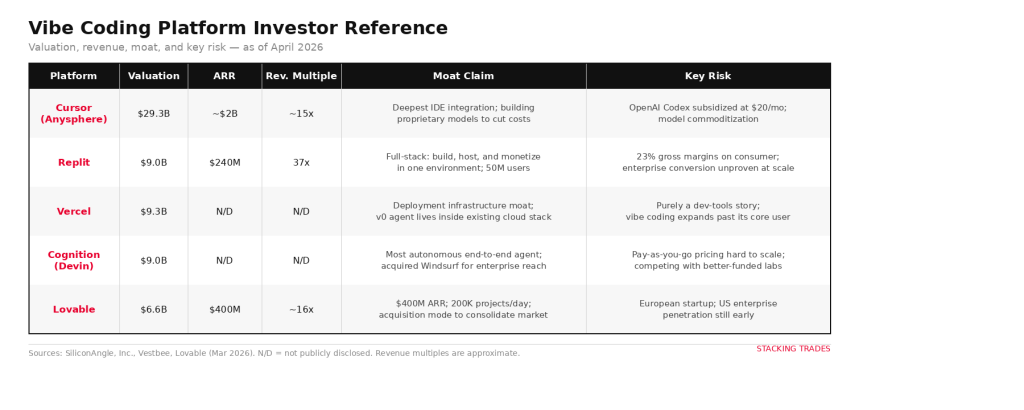
In March 2026, Replit raised $400 million at $9 billion — triple what the company was worth six months earlier. Its annual recurring revenue at the time of the raise was $240 million. That is a roughly 37x revenue multiple, priced into a company that did not exist in its current form two years ago and whose core product — letting anyone build a functioning app by describing what they want in plain English — was not commercially viable three years ago.
The number that made investors move was not the valuation. It was the trajectory. Replit’s ARR stood at $2.8 million at the end of 2024. By September 2025 it had reached $150 million annualized. By early 2026, the company was at $240 million and targeting $1 billion by year’s end. That kind of growth curve does not happen in normal enterprise software markets. It happens when a category is being invented in real time, and the companies inside it are capturing demand that had no prior outlet.
The category is vibe coding. And what it is doing to the market for software development — and to the companies that built the last generation of tools — is not a minor disruption. It is a structural repricing of who gets to build software, at what cost, and from whom.
What Vibe Coding Actually Is
The term was coined by Andrej Karpathy, the former OpenAI and Tesla AI lead, to describe a workflow where the developer does not write code so much as direct it — describing what they want, accepting what the AI produces, and iterating through prompts rather than syntax. Karpathy used it to describe his own experience as a seasoned engineer taking a more relaxed approach with AI assistance. The companies building the vibe coding market have taken the concept considerably further.
Replit’s Agent 4, announced alongside the March fundraise, does not present the user with a code editor at all. It replaces the traditional development environment with an interactive canvas — closer to Figma than to VS Code — where users sketch what they want and multiple AI agents execute tasks in parallel: one handling the database, another building the frontend, a third managing authentication. The company claims Agent 4 runs ten times faster than its predecessor, and notably, Replit built Agent 4 using Agent 3. The system is recursive in a way that has no equivalent in conventional software development.
Replit is not alone. Cursor, built by Anysphere, has crossed approximately $2 billion in ARR after raising at a $29.3 billion valuation — the largest in the category. Lovable, a Swedish startup, reached $400 million ARR with over 200,000 new projects created on its platform daily, and announced in March that it is actively pursuing acquisitions to consolidate the market. Cognition’s Devin product, which takes a more autonomous agentic approach to end-to-end coding tasks, raised at a $9 billion valuation after acquiring Windsurf. Vercel, best known for Next.js and its cloud hosting stack, raised $300 million at $9.3 billion on the thesis that its v0 agent — which deploys directly into its existing infrastructure — has an operational moat pure AI coding tools cannot replicate.
The category has attracted more than $5 billion in venture capital since 2024, with the pace accelerating sharply into 2026.
The February Selloff Was the Market Asking a Question
In early February 2026, roughly $285 billion in enterprise software market capitalization disappeared in a matter of weeks in what analysts labeled the SaaSpocalypse. The proximate cause was a cluster of agentic AI announcements, but the underlying logic was vibe coding: if a non-developer can build a functional CRM, project management tool, or internal workflow app from a text prompt in under an hour, the case for paying $50 to $200 per seat per month for a rigid SaaS product becomes harder to make.
The categories hit hardest were horizontal SaaS tools — the ones whose value has always been in packaging functionality, not in deep domain expertise. Vertical software with regulatory complexity, compliance requirements, or specialized data moats was less affected. Healthcare platforms, financial services infrastructure, and government-specific systems held their valuations because their value is not in the UI layer that vibe coding can now generate on demand.
For sophisticated investors, the February selloff was not a verdict. It was a question being priced in real time: which software companies have moats that survive prompt-based app generation, and which ones are selling something that a $15 session can approximate? That question does not have a clean answer yet. But the fact that the market is asking it — loudly, with $285 billion in market cap at stake — tells you something about where institutional money thinks the risk is concentrated. The per-seat model under pressure is playing out on the same fault line.
The Revenue Multiples Require a Specific Bet
Replit at 37x revenue, Cursor at an implied multiple well above 10x on $2 billion ARR — these numbers only make sense if you believe a few things simultaneously. First, that the total addressable market for software creation is about to expand dramatically, not merely shift. Second, that the leading platforms will capture durable market share rather than getting commoditized as the underlying models improve and the cost of inference falls. Third, that enterprise adoption — where gross margins are far healthier than consumer — scales fast enough to justify the valuations before the next funding cycle.
Replit’s own unit economics illustrate the challenge. The company reported gross margins around 23% in mid-2025 across its full user base, well below software industry norms — a direct consequence of the compute costs embedded in running AI agents at scale for 50 million users. Enterprise margins, by Masad’s own account, run closer to 80%. The strategic implication is clear: consumer user counts are the acquisition story, but enterprise contracts are the business. The company’s disclosure that employees at 85% of the Fortune 500 are building on Replit is doing a lot of work in the pitch deck, but it is not the same as saying 85% of the Fortune 500 has an enterprise contract.
Cursor’s position is structurally different. With $2 billion in ARR at a $20 monthly Pro subscription price point, the company has demonstrated it can convert developer adoption into recurring revenue at scale. Its challenge is the reverse of Replit’s: Cursor serves developers who can read the code it produces, which makes it harder to expand the market to non-technical users. OpenAI’s Codex serves over 2 million weekly users, a direct competitor operating from a subsidized cost structure that Cursor cannot match without building its own models — which it is reportedly doing.
What This Means for the Developer Hiring Market
The labor market argument embedded in vibe coding valuations is more consequential than the software market argument, and it is receiving less attention. Klarna’s CEO prototypes ideas himself rather than tasking engineers — filtering his own ideas before they ever reach his technical team. Google CEO Sundar Pichai said publicly that he has been using Replit and Cursor to build personal tools. Replit’s Masad regularly cites the case of a user who built a working ERP for $400 instead of paying a vendor’s quoted price of $150,000.
These are anecdotes. But they point to a structural shift in who initiates software projects, who approves them, and what the minimum viable internal tool looks like. If a product manager can prototype and ship an internal dashboard without an engineering ticket, the demand signal that feeds junior developer hiring weakens at the margin. If a small business can build a customer portal without a contract, a category of development agency work disappears. The platforms are not replacing senior engineers solving genuinely hard problems. They are compressing the long tail of routine software requests that previously required human time to execute.
Gartner projected that 60% of new code will be AI-generated by the end of 2026. Stack Overflow data put the share of developers using AI coding tools daily at 92% as of early 2026. These numbers suggest the baseline has already shifted. The vibe coding platforms are competing not just with each other but with GitHub Copilot, with Claude Code, with every AI coding assistant that hyperscalers and frontier labs are bundling into their existing developer relationships.
“Replit is kind of replacing a lot of the no-code, low-code tools, which really never worked very well. They get initial productivity boosts, but a lot of times that ended up actually slowing down a lot of companies.”<
— Amjad Masad, CEO, Replit, interview with B-17, October 2025
The Competitive Risk Nobody Is Pricing
The vibe coding platforms have a problem that their valuations do not fully reflect: they run on models they do not control. Replit, Cursor, Lovable, and their peers are inference wrappers around Anthropic, OpenAI, Google, and xAI models. When those models improve, the platforms improve — but so does every competitor using the same underlying intelligence. When OpenAI bundles Codex into ChatGPT for $20 a month, or when Anthropic ships Claude Code with capabilities that rival standalone IDEs, the differentiation argument for dedicated vibe coding platforms becomes harder to sustain.
The platforms’ response is to build up-stack and down-stack simultaneously. Replit’s full-stack deployment model — where the app is built, hosted, and monetized within the same environment — creates lock-in that a raw model API cannot replicate. Cursor is building in-house models. Vercel’s deployment infrastructure is the moat. Cognition acquired Windsurf to expand its enterprise footprint. These are real competitive responses, but they are expensive, and they require each platform to win a land grab before the model providers close the gap.
The $9 billion question — repeated across Replit, Cursor, Cognition, and Vercel simultaneously — is whether these platforms have enough of a lead, and enough of a moat, to sustain their valuations when the next round of model releases arrives. The revenue growth says yes. The margin structure and competitive exposure say the jury is still very much out.
What to Watch Next
- Replit’s Agent 4 launch, delayed to May 2026 — the first major product test of whether a fully canvas-based, multi-agent development environment converts at scale beyond the early adopter base.
- Cursor’s in-house model development timeline. If Anysphere ships a proprietary model competitive with Anthropic and OpenAI, its margin structure changes materially and the $29.3 billion valuation becomes easier to defend.
- Enterprise contract disclosures. Both Replit and Lovable have cited Fortune 500 presence; watch for any revenue breakdowns that clarify what share of total ARR comes from enterprise vs. consumer.
- Competitive moves from hyperscalers. AWS, Google Cloud, and Microsoft Azure each have developer distribution that none of the vibe coding platforms can match — monitor whether any bundle a comparable product into existing cloud agreements at materially lower price points.
- Junior developer hiring data in tech. If vibe coding is compressing demand for routine software work, the signal will show up in job postings and entry-level engineering salary trends before it shows up in any platform’s ARR report.