


Republic has listed more than two dozen Mirror Tokens tied to some of the most closely watched names in private markets: SpaceX, Anthropic, OpenAI, TikTok parent ByteDance, Canva, Epic Games, Ramp, Databricks. Investors can buy in for as little as $50. The product is available to non-accredited investors. The minimum commitment is small enough to pay with Apple Pay or a stablecoin. And as of May 2026, the SEC has issued no formal guidance on what these instruments actually are.
That last fact matters more than any of the others.
The Instrument Republic Built and Nobody Has Classified
Mirror Tokens are issued by RepublicX LLC, a subsidiary of Republic, under Regulation Crowdfunding for the non-accredited tranche and Regulation D for accredited investors. They are structured as contingent payout notes — debt instruments, not equity — with payout tied to a qualifying liquidity event at the underlying private company: an IPO, an acquisition, or a dissolution. If no event occurs within ten years of issuance, investors receive a proportional payout based on the then-prevailing per-share value of the target company’s common stock.
The rSPAX offering, Republic’s SpaceX-linked Mirror Token, set its reference price at $275 per share. The first tranche closed in October 2025 at a $400 billion implied SpaceX valuation. By January 2026, secondary market pricing had pushed SpaceX’s implied value to roughly $800 billion, and Republic was touting what looked like a paper 2x return for early rSPAX holders. A second rSPAX offering launched in early 2026 at a reference price of $275 on a different valuation baseline. With SpaceX now in active IPO preparation targeting a June 2026 Nasdaq listing, the product’s first real payout test is approaching faster than anyone anticipated when the first tokens were issued.
Alongside rSPAX, Republic has listed rAnthropic, giving retail investors exposure to a company that raised at a reported $900 billion pre-money valuation in May 2026. The product line is expanding. The regulatory framework governing it is not.
“This is a big step forward on our quest to make the private markets more accessible and liquid — globally. By combining regulation and blockchain innovation, we’re unlocking a future where anyone, anywhere, can invest in the companies shaping our world.”
— Kendrick Nguyen, Co-Founder and CEO, Republic, June 25, 2025
The Gap the SEC’s January Statement Did Not Close
On January 28, 2026, the SEC’s Division of Corporation Finance, Division of Investment Management, and Division of Trading and Markets issued a joint statement on tokenized securities, the most comprehensive guidance to date on how the agency treats blockchain-recorded ownership. The statement reiterated that “securities, however represented, remain securities” and established a taxonomy distinguishing between issuer-sponsored and third-party-sponsored tokenization models. It was a meaningful clarification for tokenized Treasuries, tokenized equities, and the DTC’s pilot program. It was not guidance on synthetic exposure products structured as contingent debt.
Mirror Tokens are not tokenized SpaceX shares. They are debt instruments issued by RepublicX, whose payout is calculated by reference to SpaceX’s share price. SpaceX has explicitly stated it is “entirely unaffiliated” with the offering, has not authorized it, and has provided no information to RepublicX for use in its disclosures. The January statement addressed what happens when you put an actual security on a blockchain. It did not address what happens when you create a new security whose value is derived from, but legally disconnected from, a different company’s equity.
That gap is not an oversight. It is the product’s core structural feature — and its central risk.
What Industry Critics Said — and Why the SEC Hasn’t Answered
The Crowdfunding Professional Association moved quickly. In August 2025, the CfPA issued a formal statement opposing the use of Reg CF for Mirror Token offerings, citing four areas of concern: dual-layer risk (exposure to both the underlying company’s performance and RepublicX’s own solvency), regulatory misalignment (Reg CF was designed to fund operating businesses, not route capital into synthetic instruments referencing unaffiliated private companies), the dangerous precedent of allowing unlimited parallel token issuances on the same underlying company, and complexity that retail investors are not equipped to evaluate.
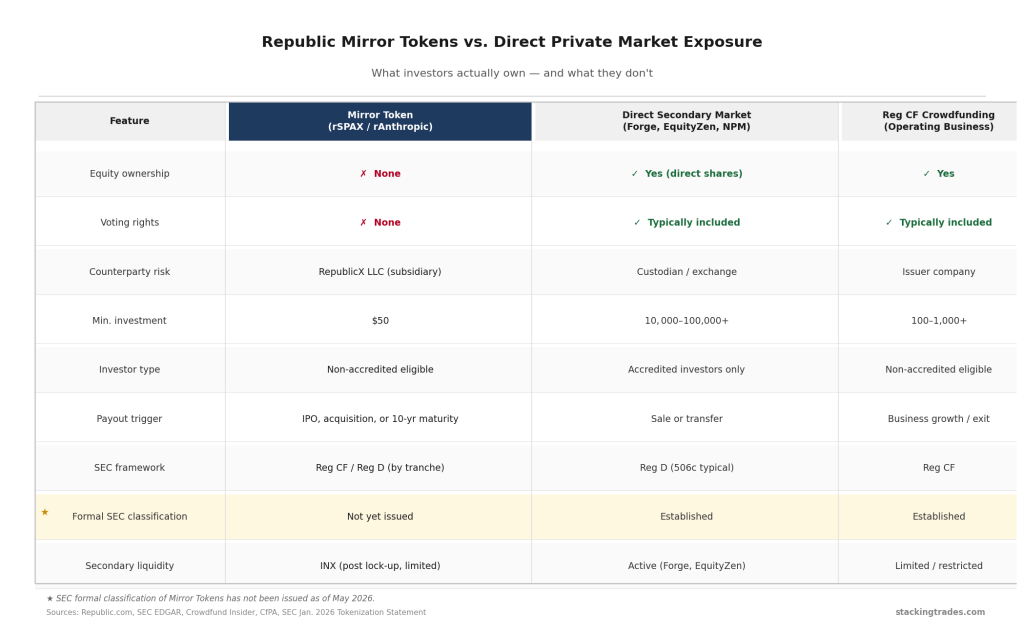
The CfPA’s critique is not simply a turf complaint. It names something precise: Reg CF was written to connect capital to businesses, not to serve as a distribution channel for financial derivatives. A retail investor buying rSPAX is not funding SpaceX. They are funding RepublicX’s ability to hedge its payout obligation, and they are taking on RepublicX’s credit risk as a counterparty in the process. SpaceX receives nothing. The $5 million raised under Reg CF per offering goes to RepublicX, which then determines how to manage its own exposure to SpaceX’s share price.
None of this is necessarily illegal. Republic’s CEO Kendrick Nguyen told the Wall Street Journal at launch that the structure “would comply with current securities rules, but regulators could still take a different view.” That candid framing captures the situation accurately. Republic has filed Form C documents with the SEC for individual offerings. The SEC has accepted those filings. Acceptance of a filing is not approval of a product category. There has been no formal guidance on whether Mirror Tokens, as a class of instrument, fit within Reg CF’s legislative intent, and no enforcement action has followed.
The Atkins Question: Innovation Exemption or Formal Rulemaking?
SEC Chair Paul Atkins has signaled a clear directional preference. He has stated publicly that the agency views stock tokenization as an innovation it will encourage, and his November 2025 remarks at the Federal Reserve Bank of Philadelphia outlined a taxonomy that treats tokenized securities as securities without imposing new burdens. At the 2026 DC Blockchain Summit, Atkins described plans for an innovation exemption that would allow limited trading of tokenized securities on novel platforms as a step toward a longer-term regulatory framework.
Republic has engaged directly with the SEC on these questions. In April 2026, Crowdfund Insider reported that Republic had met with the Commission to discuss secondary market guidance and the innovation exemption concept. The company sees Atkins’ framework as a potential pathway for legitimizing and expanding its Mirror Token infrastructure. The practical question — which Atkins has not yet answered — is whether the innovation exemption would cover synthetic debt instruments referencing unaffiliated companies, or whether it is scoped more narrowly to instruments that represent actual tokenized ownership of registered securities.
That scoping decision is not a technicality. It determines whether Mirror Tokens become a foundational product category in the retail private markets landscape, or whether they require structural redesign to survive a formal regulatory process. The distinction matters to every platform watching Republic’s experiment from a distance.
The Payout Test Is Coming Before the Regulatory Answer
The regulatory ambiguity would be easier to ignore if the SpaceX IPO were still years away. It isn’t. SpaceX has publicly filed its S-1 and is targeting a June 2026 Nasdaq listing at a reported valuation of $1.75 trillion to $2 trillion. If SpaceX prices at or near that range, rSPAX holders who bought at the $275 reference price in late 2025 would stand to receive a substantial payout — more than ten times their reference price if the IPO values each common share well above that baseline. That would be a powerful commercial proof point for the Mirror Token model.
It would also be the moment when the credit risk embedded in the product structure becomes real and visible. RepublicX LLC — a subsidiary, not the parent company — is the counterparty for every payout obligation. Republic has indicated it plans to hold shares of, or maintain some other exposure to, the underlying securities. But the exact hedging structure is not publicly disclosed, the subsidiary’s capitalization is not publicly disclosed, and the mechanics of how a mass payout would be executed across tens of thousands of token holders on a Solana-based token infrastructure have not been demonstrated at scale.
The SEC’s silence on Mirror Token classification means that if something goes wrong during a payout event — a hedge fails, a subsidiary is undercapitalized, a liquidity crunch creates delays — the existing regulatory framework offers retail investors the protections of a Reg CF debt instrument, not the protections of a securities holder in SpaceX. That difference is not trivial. It may not matter if RepublicX executes cleanly. It will matter enormously if it doesn’t.
Why This Isn’t Just a Republic Problem
Mirror Tokens are Republic’s product, but the structural question they raise applies to the entire direction of retail private markets access. Robinhood has launched tokenized equities in the EU. BlackRock has expanded its tokenized fund infrastructure. The crowdfunding platforms watching Republic’s regulatory experiment are doing so because the same SEC decision that shapes Mirror Tokens will also shape what any of them can build next.
If the SEC provides formal guidance that blesses the Mirror Token structure — whether through the innovation exemption, a no-action letter, or formal rulemaking — it opens a category. Any platform with a broker-dealer relationship and a blockchain infrastructure could issue synthetic exposure notes tied to private companies their users can’t otherwise access. The $5 million per offering Reg CF cap becomes a different constraint when the underlying company is SpaceX rather than a seed-stage startup. If the SEC moves in the other direction and determines that Mirror Tokens don’t fit within Reg CF’s purpose, the product category needs to find a different exemption or a different structure entirely.
Republic has built something genuinely novel, and it has done so at a moment when both the regulatory environment and the IPO calendar have aligned to give the product its most visible test yet. The question that has been left open since June 2025 — what Mirror Tokens actually are, under the law — is about to get much harder to defer.
What to Watch Next
- The SpaceX IPO pricing and rSPAX payout mechanics. If SpaceX prices above $275 per share at its June 2026 listing, the first mass Mirror Token payout event will be the product’s most consequential proof of concept — and the clearest test of RepublicX’s hedging infrastructure and counterparty capacity at scale.
- SEC formal guidance on Mirror Token classification. The innovation exemption that Chair Atkins has described may or may not cover synthetic debt instruments referencing unaffiliated companies. Any formal SEC statement, no-action letter, or comment letter directed at Republic’s Reg CF filings would define the product category’s legal foundation — or require a structural redesign.
- Republic’s capitalization disclosure for RepublicX LLC. The subsidiary is the payout counterparty for every active Mirror Token offering. Its balance sheet has not been publicly disclosed. As the number of live offerings expands and payout events approach, the adequacy of that capitalization becomes the central underwriting question for retail investors holding these instruments.
- Competitive response from other platforms. If the SpaceX payout executes cleanly and generates significant retail returns, expect Wefunder, StartEngine, and new entrants to explore comparable synthetic exposure products. The regulatory framework that emerges from Republic’s experience will set the terms for the entire category.
- The Anthropic IPO timeline and rAnthropic token exposure. With Anthropic telegraphing an October 2026 IPO window and having raised at a reported $900 billion valuation, rAnthropic holders face a similar payout calculation. The sequence of SpaceX and Anthropic liquidity events in the same calendar year would be an unprecedented test of the Mirror Token model’s operational capacity.