


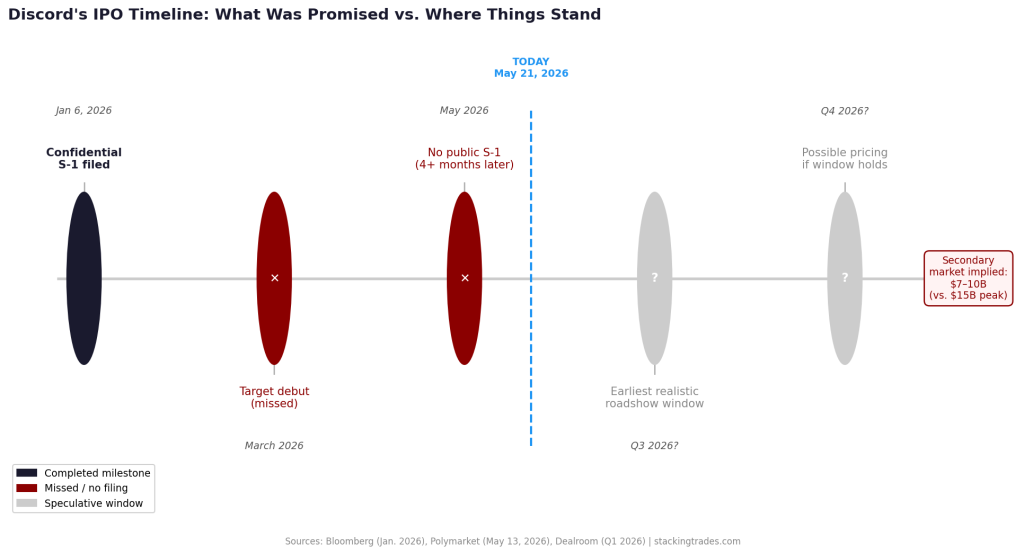
Discord confidentially filed for an IPO on January 6, 2026. Goldman Sachs and JPMorgan Chase were mandated as lead underwriters. A March debut was the stated target. It is now May 21 — nearly five months later — and there is no public S-1 on file, no roadshow date, and no pricing window. SpaceX dropped its long-awaited public prospectus on May 20. Discord has said nothing.
The silence is the story.
A Window That Opened, Then Moved
When Discord filed confidentially in January, the setup looked favorable. The IPO market had come off its best year since 2021, with tech new issues raising more than double the 2024 total. Institutional investors were talking up a banner 2026. The consensus at the time was that Discord, with over 200 million monthly active users and a recognizable consumer brand, was exactly the kind of platform that could lead the first wave of large consumer-internet listings.
Then the window moved. The geopolitical shock in late February — U.S. and Israeli strikes on Iran — sent volatility higher and compressed the IPO calendar for nearly all issuers. Discord’s March target became unreachable without a public S-1 already on file. Companies typically need a minimum of three to four weeks between a public filing and pricing, plus the SEC review back-and-forth that can add weeks more. Discord had none of that runway.
The market has since stabilized. The S&P 500 is up roughly 0.6% year-to-date as of mid-May. SpaceX filed publicly on May 20. If there was ever a moment for Discord to follow, this is it — and it still hasn’t.
What the Secondary Market Is Saying
Polymarket, which now runs prediction markets on private company valuations, offers the most direct read on how traders are pricing Discord’s situation. As of May 13, prediction market traders assigned a 74.5% implied probability against a Discord IPO by June 30, 2026. The reasoning is mechanical: without a public S-1 in hand, there is not enough calendar to complete SEC review, conduct a roadshow, and price before the end of June.
The valuation signal is more pointed than the timing odds. Secondary market trading values Discord at $7 to $10 billion — well below the $15 billion it commanded in its last private raise in 2021. That is a meaningful discount for a company that has not formally revised its valuation target. If those secondary prices hold, Discord faces a choice between pricing below its 2021 round — a headline that becomes its own story — or waiting for a market environment where it can defend a higher number.
The Revenue Problem That Won’t Go Away
Discord generated an estimated $561 million in revenue in 2025, growing from roughly $130 million in 2020. That growth rate is real. The monetization structure, however, is the part that public-market investors will push on hardest. The company earns primarily through Nitro, its premium subscription service, with roughly 7.3 million subscribers as of mid-2025 at an average of about $47 per user annually. Add server boosts and the early advertising business, and the math still produces a revenue per user figure of roughly $2.16 across its full 200-million-plus monthly active base.
That number sits well below comparable consumer platforms. Snap generates roughly $10 per user. Pinterest is around $8. Even Reddit, which only recently went public and has faced its own monetization questions, lands near $6. The gap reflects what Discord built — a community-first platform that made generous free features central to its identity — and the tension that creates the moment quarterly earnings become a public-market obligation.
Discord has been reporting positive adjusted EBITDA for multiple consecutive quarters as of early 2025, per Sacra, which tracks the company’s financials through available disclosures. But adjusted EBITDA and GAAP profitability are different conversations, and the distinction will matter when the S-1 eventually lands and analysts can compare reported losses against the platform’s growth story.
The Strategic Case for Waiting on SpaceX
There is a version of Discord’s silence that is not a problem but a plan. SpaceX’s public S-1 — filed after markets closed on May 20 — will dominate IPO coverage for the next several weeks as analysts parse the Starlink revenue breakdown, xAI integration terms, and dual-class share structure. SpaceX’s reception will set the reference point for how institutional investors price the 2026 vintage of large private listings. If the S-1 lands well and demand materializes, it creates a favorable pricing environment for every issuer behind it in the queue.
Letting SpaceX go first is rational sequencing. A $15 billion consumer platform with a monetization gap does not want to compete for investor attention against the largest IPO in market history. Filing in June or July, once the SpaceX roadshow is done and the window is confirmed open, is a defensible strategy — as long as the S-1 is ready and the SEC review is already underway in confidence.
The problem is that no one outside Discord and its bankers knows whether that review is progressing smoothly or whether SEC comment letters have raised issues that are slowing the process. That opacity is exactly what the confidential-filing process is designed to preserve.
What the Founder Said — and What Happened Next
In November 2024, co-founder Jason Citron was explicit about his ambivalence toward the public markets in an on-record interview with Harry Stebbings on the 20VC podcast.
“There will have to be some liquidity situation eventually, because [investors, employees] want to get paid, rightfully. But when and how and what, we’ll figure that out as we move on. But I don’t wake up and go like, I cannot wait to be a public company and do earnings calls. That’s not the reason why I started the company.”<
— Jason Citron, Co-Founder, Discord, 20VC Podcast, November 2024
Two months later, Discord filed confidentially for an IPO. Five months after that, Citron was no longer CEO. Discord appointed Humam Sakhnini — former Vice Chairman of Activision Blizzard and President of King Digital Entertainment — as CEO in April 2025, effective April 28. Citron transitioned to board member and advisor. The move was widely read as deliberate IPO preparation: Sakhnini ran King as a public company and grew its operating profit from $600 million to $1.3 billion during his tenure. He is the executive who will sit across from institutional investors on the roadshow, not Citron.
The leadership transition is the clearest signal that Discord’s IPO calculus is driven by LP and employee liquidity pressure, not founder enthusiasm. The company has raised roughly $995 million across multiple rounds. The 2021 class of investors is now five years in. That pressure does not dissipate because the window is complicated — and swapping in a public-company operator as CEO does not happen unless a listing is genuinely imminent on the internal timeline, even if the external calendar keeps slipping.
What Sakhnini’s profile tells you is something different from what Citron’s quote suggested. A CEO who built operating discipline at a publicly traded gaming company, managing franchises under quarterly earnings scrutiny, is a different posture than a founder who built Discord because he wanted to. Whether that operational instinct translates into monetization moves that hold the user base together — or chip away at the community-first culture that made the platform worth $15 billion in the first place — is the question the S-1 will not be able to answer but roadshow investors will ask anyway.
What to Watch Next
- The public S-1 filing on SEC EDGAR. Discord can file at any point; the absence of a filing as of late May means Q3 is now the earliest realistic roadshow window. Any filing before June 15 would preserve a slim chance at a summer pricing date.
- Secondary market pricing through Forge Global and EquityZen. If Discord’s implied valuation on secondary platforms moves back toward $12 to $15 billion, it signals that institutional traders believe a near-term filing is coming. If it stays flat or compresses further, the delay thesis gains credibility.
- SpaceX’s first-day pricing and aftermarket performance. If SpaceX prices at or above its implied $1.5 trillion valuation and holds above the issue price in the first week, it opens the window for every name behind it. If it struggles, Discord’s bankers will push the timeline again.
- Any public commentary from Jason Citron or Discord’s investor relations team. The company has been near-silent publicly since the January filing news broke. Any conference appearance, press interview, or partner announcement that touches on the IPO path is a signal worth tracking closely.
- Nitro subscriber and ARPU growth in the S-1 when it arrives. The distance between Discord’s reported $2.16 per user and the $6 to $10 range achieved by ad-supported peers is the core valuation debate. Any disclosure of subscriber growth acceleration or advertising revenue approaching Nitro scale would materially shift the pricing conversation.